

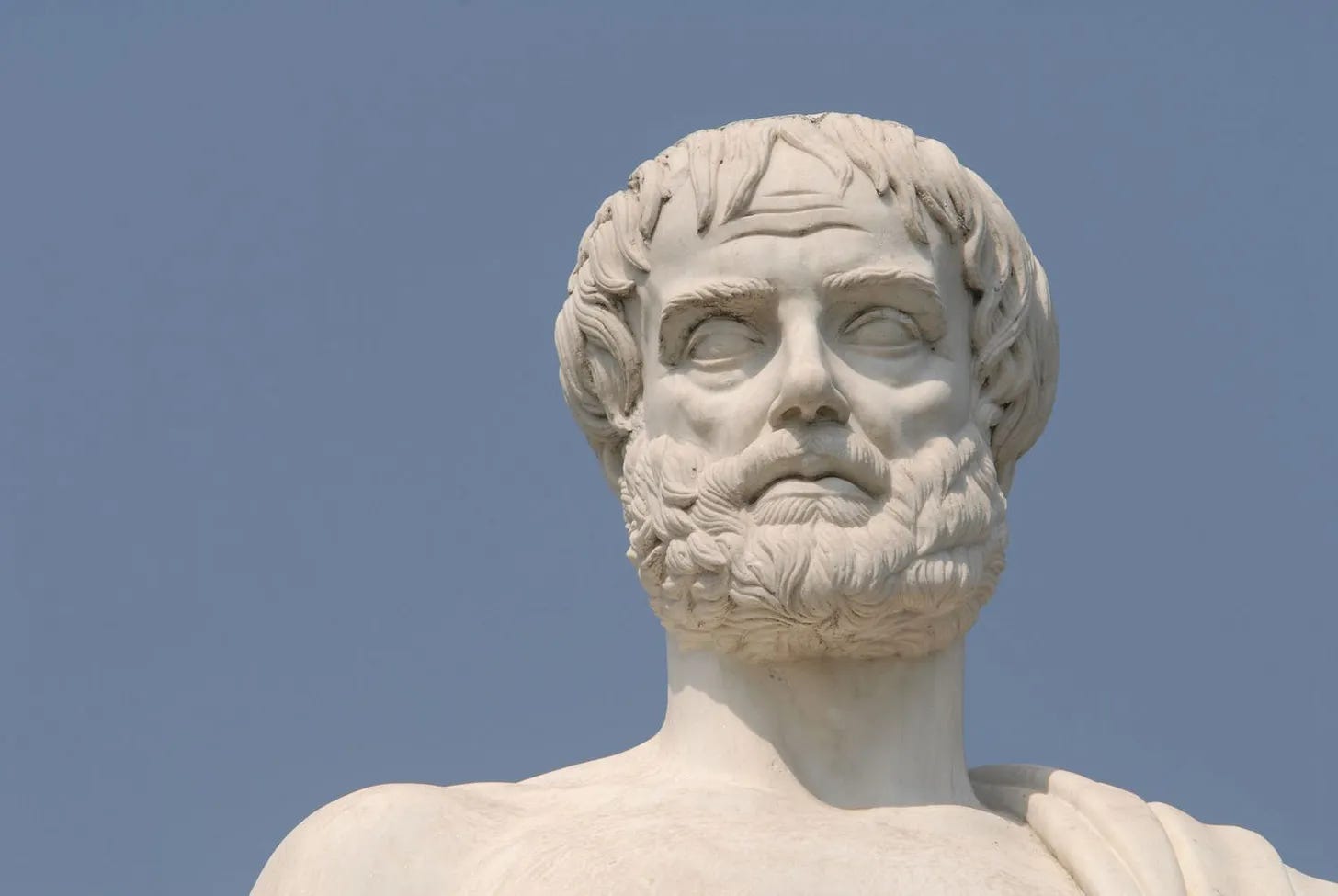
We can often think of philosophy as being completely impractical. While many people spend their time thinking about how to make their career, family or hobbies more successful, philosophers just sit around…thinking about stuff. Right?
Not Aristotle.
For Aristotle, his ethics are eminently practical. So much so, in fact, that his works on ethics and politics are focused primarily on how to live a good life and make your city better.
Moreover, these are not vague, “everybody should get along”-type answers. They have to do with concrete and specific ways that better living leads to happier people. So today, we are going to see three life lessons from Aristotle’s Nicomachean Ethics, and how they can help us improve our lives today.
Don’t forget to join our book club!
We’re currently reading Aristotle’s Nicomachean Ethics together! The next discussion is TOMORROW, July 7, at noon ET — join us!
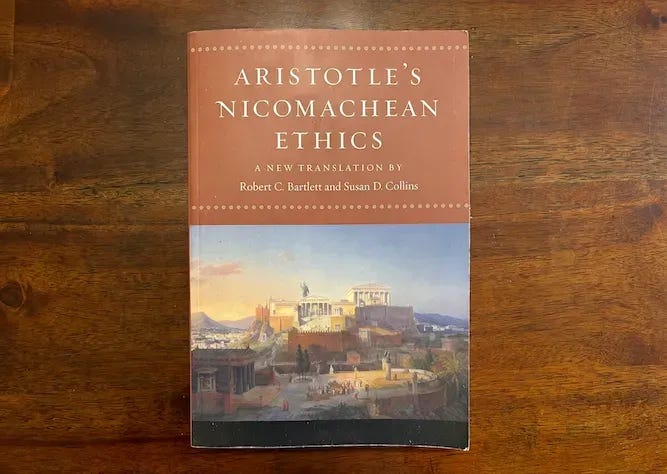
To support our mission, please consider a paid subscription. It makes a HUGE difference to the time and resources we can dedicate. You’ll get:
Live book discussions (biweekly) and recordings
Access to our incredible community of readers
Regular essays to guide you through the books we’re reading
The entire library of articles, essays, and podcasts
You can find the Zoom link to tomorrow’s live discussion here.
Lesson 1: Keep The End Goal In Mind
One of the most important principles of Aristotelian ethics is that a thing’s goodness is determined by its purpose and the degree to which that thing achieves its purpose.
That might sound complicated or esoteric, but it actually makes a lot of sense. Consider it this way: what makes a good pencil? Presumably, it needs to write well, and do whatever facilitates good writing. So if it does, in fact, mark paper, does it smoothly, doesn’t smudge, is comfortable in the hand, and so on, it is a good pencil. And not for some moral or theoretical reason: its goodness is completely determined by what it is for.
This means that knowing a thing’s purpose is crucial for determining whether it is good or not. To keep a trivial example, imagine that you thought that a cue stick was meant to be a pencil. The cue stick could be the fanciest, most impressive cue stick in the world, but you would still think it was poorly made, by someone who doesn’t understand pencils; it doesn’t even have something to write with unless you put chalk on the end!
Frequently, poor solutions to problems come about because the solution forgets the actual goal the solution is supposed to pursue. This is what happens when disciplinary rules focus on external appearances but allow any manner of actual vice that gets around them. In especially bad cases, the solution can be worse than the problem itself.
So next time you have to solve a problem, stop and remember Aristotle, and ask yourself: what is the end-goal here? Why am I doing this in the first place? It will help you make a more focused solution. And that is important, because it is not always obvious what the right solution is. Fortunately, Aristotle has some advice for that, too…
Lesson 2: Virtue is Found in the Middle
Aristotle held that a sound ethics discerned good habits, called virtues, directed towards particular goods. But he pointed out that, typically, virtue is found in the middle of an excessive response and an insufficient response.
Pursuing justice, for example, is good. Virtuous even. But seek to exact every single “fair” result you possibly can, and you are going to be exacting and unmerciful in a way that is no longer justice. But be careful; in an attempt to not be over-exacting, you might also let too much by, so that justice is not served.
This theory is the famous “golden mean” theory of Aristotelian ethics, and it is a fundamental principle of wise living and wise governance. While it can be tempting in important circumstances to lean heavily towards laxity or exactness in every instance, that is not always what is demanded by virtue. Instead, the virtuous man is going to find the mean between excess and deficiency in every instance.
Importantly, this is not the advocacy towards a vicious passivity. You could read this and think that Aristotle never thought it was right to make a strong decision. But really, what he is calling for is that all of our actions be governed by reason. Unfortunately, that is not always possible on our own, which is why Aristotle offers this third lesson…
Lesson 3: We Can’t Be Good By Ourselves
Aristotle calls human beings political animals, which means that we do not exist solely for ourselves. Rather, we are directed not just for our own good, but for the good of our community.
This has two implications on what it means to be a good person living a fulfilled life:
Virtue is other-centered. A virtuous person is not focused only on his own goods. If someone is only ever looking out for himself, he won’t be virtuous, no matter how hard he tries. And as Aristotle points out, he will not be happy either. After all, Aristotle’s rules are not external instructions like “please do not step on the grass.” Rather, they are instructions on how to live a happy, fulfilled life. You shouldn’t be moral because it will make your Mom happy. You should be moral because you will be miserable otherwise. And without a healthy community that you are working towards, you will be miserable.
Virtue comes from a healthy community. You cannot be virtuous if you are surrounded by people making you vicious. The community you are in determines a lot about who you are, how you live, and what you live for. Since we are political animals, we grow in virtue or vice as our community at large does, too. Notice that this means that you and your friends have a responsibility to each other. You can, and in fact you should, help your friends become more virtuous people! And if you do not do so, they will not be as happy as they ought to be.
Fundamentally, Aristotle’s point is that no person is only responsible for herself. Whether you like it or not, your virtue both impacts, and is dependent on, the people around you. So choose carefully.
The Important Questions
To close, ethical philosophy at its best is not about coming up with annoying answers to bizarre thought experiments. It’s about answering the questions that matter most:
How ought I to live?
How can I be who I am meant to be?
That’s what makes Aristotle so powerful, and what makes reading him useful to everybody, even if you aren’t a philosopher…
Don’t forget to join our book club!
We are currently reading Aristotle’s Nicomachean Ethics together! The next discussion is TOMORROW, July 7, at noon ET — please join us!
You can find the Zoom link to tomorrow’s live discussion here.
"What is the end-goal here? Why am I doing this in the first place?" - Questions we should examine as TIME is finite. Pragmatism is ruled by what is real. If the opposition's nature is anti-nature, it is counter productive to engage whatsoever.
Aristotle is the best!