

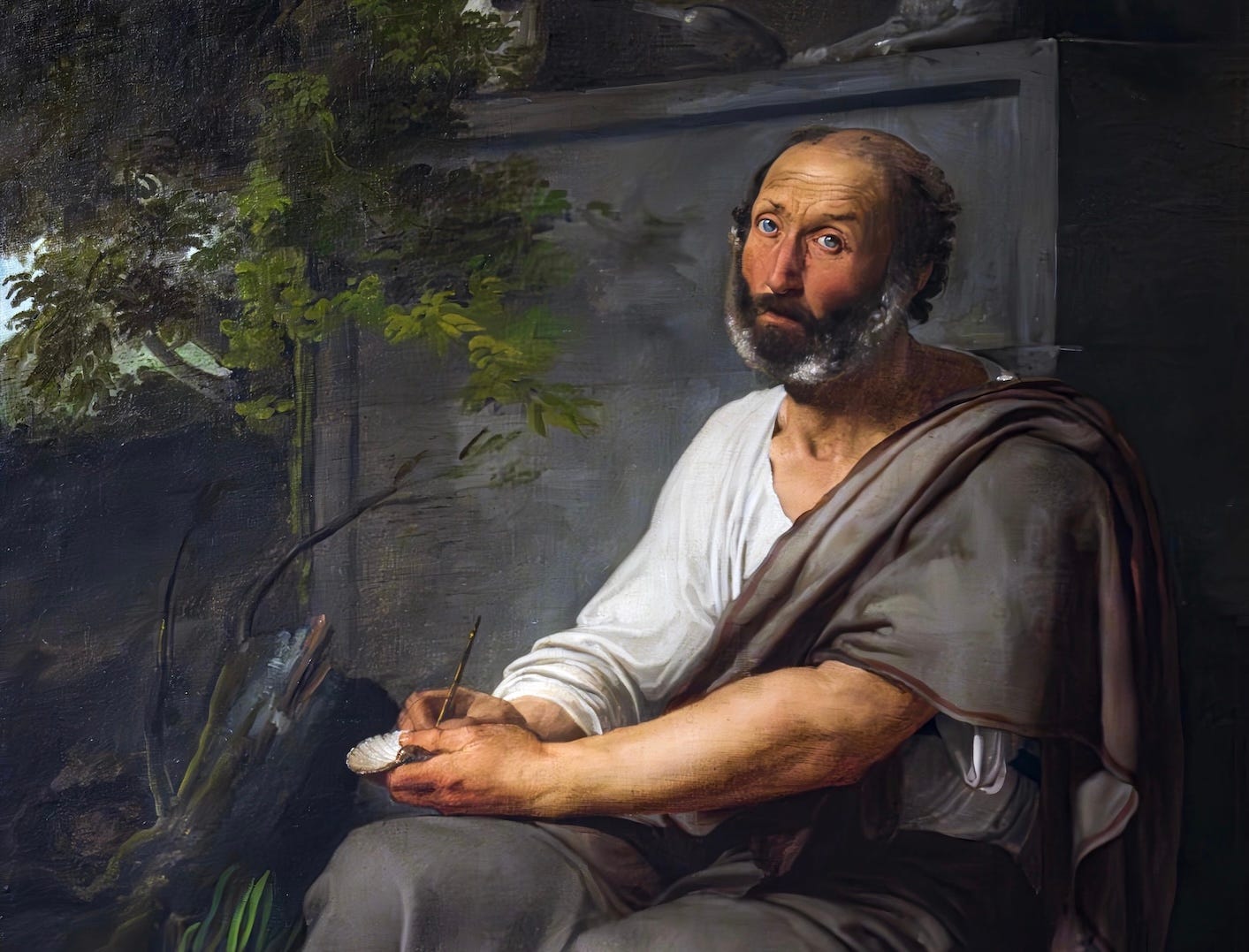
Over 2000 years ago, the Ancient Greek Philosopher Aristotle composed one of the foundational ethical texts in Western Civilization: his Nicomachean Ethics.
The book, named for and dedicated to his son, Nicomachus, laid out an ethical theory that became the dominant one in Western Civilization for well over a millennia, and remains one of the major views in academic philosophy: Virtue Ethics.
It also stands as one of the most robust examples of how to demonstrate that ethics are objective: that an individual’s personal opinions do not make ethical claims true or false.
Today, we are going to go through three important steps to understanding Aristotle’s crucial argument, and why it shows that ethics are not up to us, but are instead rules that, if left unfollowed, lead to self-destruction…
Don’t forget to join our book club!
We’re about to start reading the Nicomachean Ethics together. First discussion is Tuesday, June 9, at noon ET — covering Books 1–3.
See the bottom of this article for what we’ll be discussing during the session…
To support our mission and join our reading group, consider a paid membership:
All live book discussions (biweekly) and recordings
Access to our incredible community of readers
Regular essays to guide you through the books we’re reading
The full library of articles, essays, and podcasts
Ability to vote on what we read next…
What is the Purpose of Ethics?
People often make long arguments about ethical claims without setting out what the goal of ethics really is.
Why live a moral life?
What are we saying about an act when we say that it is immoral?
Aristotle claims that the purpose of all human beings is eudaimonia, a word that roughly translates to happiness. But unlike how many people think of happiness, this happiness is not a merely emotional, feel-good phenomenon. Rather, eudaimonia as Aristotle thinks of it is the fulfillment of a human being’s purpose. You achieve happiness when you are what you should be.
What you should be, however, is not entirely up to you. You have a nature with particular powers and capacities, and those powers and capacities have purposes, or ends, that determine what it is to be good. Indeed, Aristotle argues that what it is to be good is determined by a things purpose; a good cue stick is a terrible pencil, and both would be horrible fly swatters.
So, to be good, you must act towards your purpose of eudaimonia. And if to be happy comes from fulfilling our end, then happiness comes from our objective nature: we can only be happy if we do what we are made to do. That makes the study of ethics clear: it is the study of how to be happy.
And it helps us figure out what things make us miserable. Which takes us to objectivity.
Why Some Things Are Wrong
So how does this get us to moral claims?
Well, if the study of ethics is about how to live happily, and that happiness comes from achieving our purpose, then there is a real way to achieve our purpose and, conversely, a way to live that fails to achieve that purpose. For Aristotle, moral reasoning is meant to figure out the best way to achieve our purpose.
This means that Aristotle thinks of “this is morally right” to mean, roughly, “this is ultimately going to contribute to my own and other people’s human flourishing.” In other words, “this is good for me and the people around me.” Similarly, “this is morally wrong” means “this is going to prevent me and the people around me from flourishing.” In other words, “this is bad for me and the people around me.”
Importantly, Aristotle does not think that this boils down to “do whatever you think will feel good” because happiness is not determined by personal preference. It is eminently possible to want something that is self-destructive. And if you want something that is self-destructive, you should not get it because to have it would be bad. Moreover, to pursue it would be immoral: you are hurting yourself and everyone around you.
This makes Aristotle’s ethical theory objective, but it is also grounded in reality in a way that makes it unique amongst ethical theories. Here’s how.
How Aristotle is Unique, Even Today
Most of the rules around us are not grounded in any inherent way that the world around us works. The speed limit may be 35, and there may even be good practical reasons for it to be 35, but there is nothing intrinsic about the stretch of road you are driving on that means that it must have a speed limit of 35 miles per hour. It is just the rule that has been given, and the main reason we must follow it is that an authority, i.e. the lawmakers of the city, has told us so.

Many people think of ethical theory in this way: moral rules are a series of “shoulds” and “should nots” that have very little to do with the actual world around us and much more to do with what seems awful to us or what God tells us to do. They are, in essence, just rules like a speed limit.
This is why so many stick-it-to-authority types also reject traditional moral laws; they see moral laws as nothing more than one more way that some authority, which may or may not include God, is trying to keep us from doing something we want to do.
What makes Aristotle unique, as well as the ethical systems that sprung from his thought in St. Thomas Aquinas and others, is that his ethics are deeply grounded in the world around us.
Why should human beings take care of others? Because we were made to do so, and will be miserable otherwise. Why should human beings refuse to steal? Because our nature is directed towards honesty, stealing hurts both others and ourselves.
So, why is morality objective? Because reality is objective. There really is something that human beings are directed towards, and there really are consequences to failing to achieve that purpose.
Figuring out that purpose, and dodging the self-destruction that comes from failing to reach it, is exactly what Aristotle is doing in the Nicomachean Ethics.
Make sure you join our read-along of the Nicomachean Ethics!
The first discussion is on Tuesday, June 9, at noon ET — covering Books 1–3
Here’s what we’ll be discussing on the first call…
The Nicomachean Ethics is Aristotle’s most influential work, and has become the foundational work for moral philosophy in Western Civilization. The premise is fairly straightforward: “How do I live a good life?”
You’ll find Aristotle is a practical thinker. He doesn’t deal in abstractions, rather this work is pragmatic and to the point. You can think of this work as a sort of “how to manual,” for living a good life. If you take his writing seriously, and implement his teachings into your daily life, he asserts you will achieve a meaningful life of virtue and flourishing.
With that said, turn your attention to his definition of eudaimonia in Book 1, Chapter 7:
“The human good is an activity of soul in accord with virtue”
This becomes Aristotle’s working definition of flourishing (happiness), throughout his ethics. For Aristotle, happiness is not an emotion, but a disposition of one’s soul in accordance with their actions.
Some questions to consider as you start reading:
What actions constitute virtue?
What actions constitute vice?
Why is knowledge of virtue not enough by itself?
If someone has knowledge of virtue and vice, what are likely the biggest obstacles/hindrances that prevent them from living a life of virtue?
Consider these questions, and see if Aristotle himself offers answers in later chapters down the line. Share your thoughts in the community chat, along with any questions you have — and we’ll incorporate them into next week’s discussion!

I noted this sentence at the beginning of Book One, Chapter 8:
“For with the truth, all the given facts harmonize; but with what is false, the truth soon hits a wrong note”.
He didn’t seem to unfold the second half of this sentence, at least as far as I am in the text. But it is swirling all around us today… the truth is abused by a raging sea of falsehoods, behaving toward the truth like cornered rats.
For me the idea that Aristotle’s morality is objective is one reason it doesn’t seem he fully rejects Plato’s ‘objective’ Form of the Good, but rather is directing us to begin examining The Good at the level of particulars and also the inner world of soul in relation to action. You might say he’s putting ‘training wheels’ on Plato - suggesting we spend some time acknowledging our own desires and weaknesses before declaring ourselves ‘Philosopher Kings’. There are many instances where he finds the Good in moderation between to extremes - maybe we can’t determine the exact good for everyone in every circumstance, but we can at least get closer with the sense of Eudaimonia (or disharmony) as a guide.