

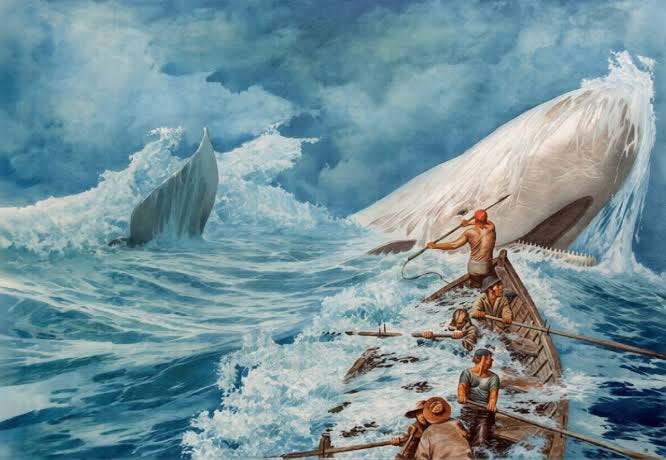
Have you ever tried to tell a story?
It’s hard. Really hard.
You may begin with a clear idea of the plot; but then, what is included in the plot? Do you need to incorporate the setting? How much of it? What about background? Do you need to tell your listeners the story of your protagonists’ childhood? First job? Broken heart?
Every storyteller knows the story he wants to tell. But how to tell that story to be the story his listeners want to hear is much more difficult. And how to make sure that the two are the same thing is the hardest of all.
Some novels, in an attempt to solve this incredibly difficult paradox, stretch the very medium of “novel” almost to its breaking point. They break rules, tell stories unconventionally, and try to surprise their readers in completely new ways.
They try, in short, to be Moby-Dick.
As we discussed recently, Moby-Dick is a novel of several major themes, perhaps the greatest two being obsession and fate. But what sets Moby-Dick apart is the way that it conveys these themes, through extreme, genre-bending experimentation. Some of the truly odd features of the novel are easy (or even tempting) to ignore on the first read. But that would be a mistake, and a loss of an opportunity to confront what makes this novel different from every other.
So today, we’re going to look at some of these experimental features, and see why they take Moby-Dick from a simple tale of whaling to one of the greatest works of literature ever written…
Don’t forget to join our book club!
We just started reading Moby-Dick together. The next discussion is on Tuesday, October 27 — watch back the first session here.
Read Moby-Dick as a member of our group and you’ll get:
Live book club discussions (biweekly) and recordings
Weekly reading guides and regular essays to guide you
Access to our incredible community of readers
The entire library of articles, essays, and podcasts
The Narrator
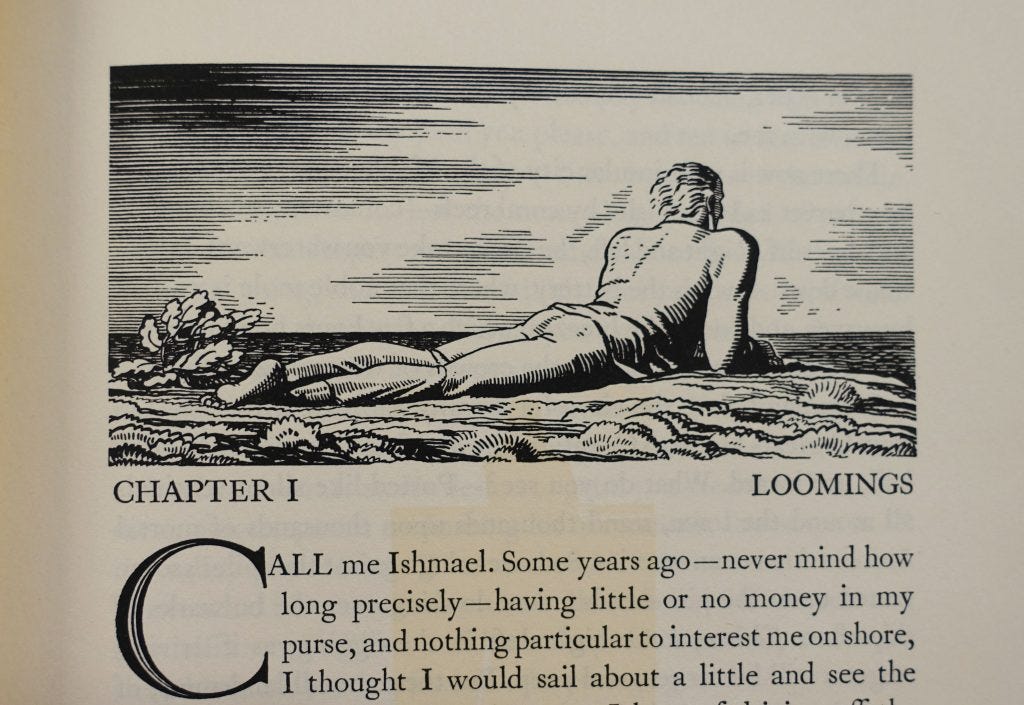
We’ll begin the same way the story does: with its opening line, one of the most famous in the English language:
Call me Ishmael.
This establishes something important about the novel: it’s not an unbiased reporting of the story. It’s a first-person account, deliberately set up as a relating of the story to the reader. This means that the story will be colored by, and reflective of, the narrator’s psychological states, including his emotions, neuroses and traumas.
It also implies that Ishmael has, in some meaningful way, made deliberate choices about how to write and (in some cases) compile the resources together that combine to form this story. When the novel gets weird (and it does), Melville is trying to reflect something particular about Ishmael. He is inviting us to “psychoanalyze” him, so to speak.
This is important to realize, because Melville provides ample material to analyze. And the first piece comes even before the famous opening line…
The Introductory Material
If you read Moby-Dick on your own, it can be tempting to skip right to Chapter 1 and its famous line, “Call me Ishmael.” But that’s not actually how the novel begins. Instead, it begins with the most (seemingly) boring possible subject: the etymology of the word “whale.”
I can hear you groaning from here, but stick with me for a second.
Why does Melville (through Ishmael) start this way? What does it tell us?
We get a clue from the second portion of the book, which is also not the first chapter: a collection of literary passages that mention whales, supposedly found by a sub-sub-librarian upon the request of, presumably, Ishmael. This paints a picture of Ishmael that is fascinating, if a little disturbing: he is a man absolutely obsessed with whales, even to the point of making other men work tirelessly for useless information that he wants.
Ishmael is collecting every piece of information he can find and compiling it into this book, with neither interest nor attempt at making it form a coherent or helpful narrative. He’s dumping whatever information he can find about whales into his book.
Melville is giving us a hint at the state of Ishmael’s mind, which should help us to interpret the rest of the book. But we’ll learn even more when we consider what comes later…
The Scholarly Chapters
As you continue reading Moby-Dick, you’ll probably be surprised to discover chapters on various works of scholarship about whales, randomly (or are they?) distributed throughout the book. The first is Chapter 32, titled “Cetology,” in which Ishmael seeks to categorize all types of whale biologically. In later chapters, he discusses whales in literature, art, food, and more.
But why is Melville including this? It has nothing to do with the story, right?
Wrong. In fact, the question “what kind of writer puts this in his story?” is exactly the kind of question you should be asking. We know that Ishmael wrote this tome. What does it tell us about him that he is constantly getting off track to tell us more about whales? Why does he want to know, much less want us to know, so much about these animals?
In a previous article we mentioned that Moby-Dick is a novel about obsession. But it isn’t just about Ahab’s obsession — it’s about the obsession that Ishmael is experiencing, too. The events of the story he is telling have affected him deeply; the book even seems to show that he has been genuinely traumatized, and that the writing of this story is Ishmael’s attempt to process that trauma.
And so we get a narrative that is gripping, but distracted. We have a powerful plot that gets side-tracked on scholarly side-quests. It all forces us to ask: Who is Ishmael? It’s not clear the narrator knows either.
Moby-Dick is the record of a man who has lost his own identity in an obsession that springs from his own traumatic experience. While some parts can seem superfluous or random, every one is actually carefully crafted to reflect a powerful, human image:
Ishmael, a man haunted by his past and that one, great, whale.
Read it with us!
Come and read this great novel with our group. If you missed the intro discussion last week, not a problem — we’re reading this over the next five weeks, and you can watch the full recording here.

We highly, highly recommend you join our core reading group. We are on a mighty pilgrimage together through the greatest books of the Western canon — and the discussions have been fantastic recently.
And if you read Moby-Dick as a member of our group, you’ll get:
Live book club discussions (biweekly) and recordings
Weekly reading guides and regular essays to guide you through
Access to our incredible community of readers
The entire library of articles, essays, and podcasts
Welcome!