

We have already covered how Dostoevsky demonstrated the self-destruction of vice in Crime and Punishment. In the book, Raskolnikov’s pride and violence lead not only to his conviction for murder, but to the erosion of his whole character.
But you’d be wrong if you thought that Dostoevsky was only concerned with action. In fact, he was just as concerned with the ways that ideas, and especially false ideas, can lead to a person’s destruction.
Those ideas are given such a demonstration in Dostoevsky’s last and greatest novel, The Brothers Karamazov.
This demonstration offers a picture of evil that is perhaps even more striking than in Crime and Punishment: the gradual, but total, collapse of Ivan Karamazov…
Don’t forget to join our book club!
We’re currently reading The Brothers Karamazov. The next discussion is on Tuesday, September 1, noon ET — join us!
Watch back the previous discussions here if you missed them.
To support our mission, please consider a paid membership. It makes a HUGE difference to the time and resources we can dedicate. You’ll get:
Live book discussions (biweekly) and recordings
Access to our incredible community of readers
Regular essays to guide you through the books we’re reading
The entire library of articles, essays, and podcasts
The Man of Great Promise
When Ivan Karamazov is first introduced, he is a flawed but relatively normal and relatable person. As a Karamazov, Ivan is naturally compared to his profligate father and blustering brother, and comes out looking incredibly well in the comparison. In fact, Ivan seems to be a positively sympathetic character: he’s no Alyosha, but he seems to have his head on straight, at least.
In fact, Ivan has his head more than on straight. He’s a philosopher and a truly brilliant writer — so much so that he writes essays on theology that confound even the learned monks and theologians of the local monastery.
There’s just one problem: Ivan is deeply nihilistic, too. And while this isn’t exactly grounds for major concern in the beginning — at least he’s not his father or brother — the consequences of the novel’s central murder are arguably worst of all for Ivan because of this…
Ivan’s Most Dangerous Idea
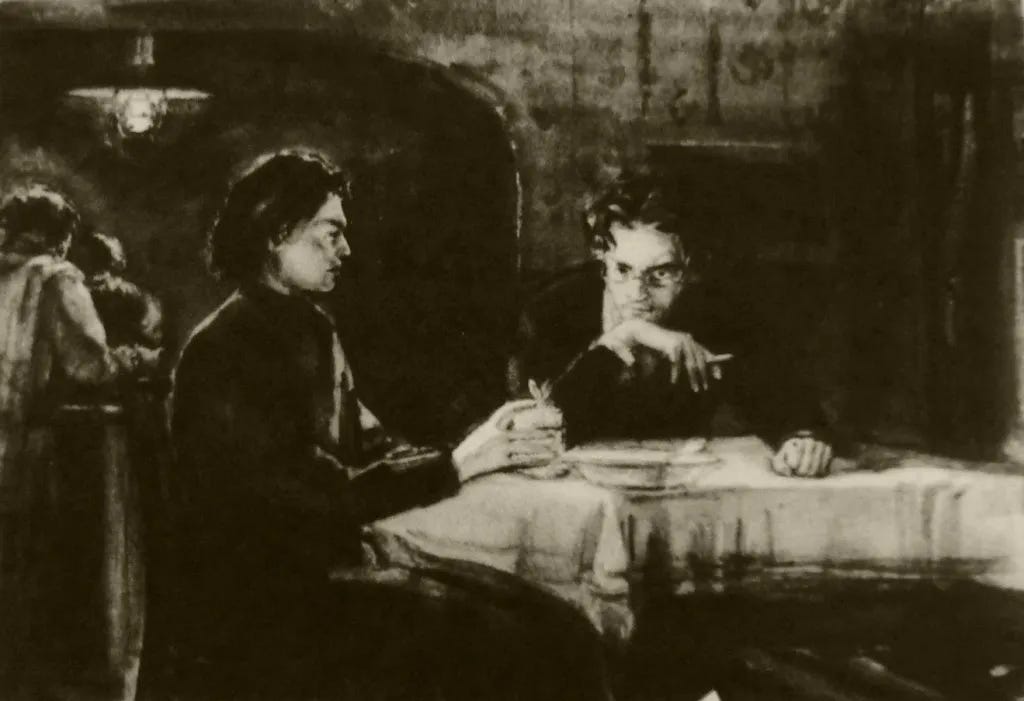
Early in the novel, Ivan argues with his pious brother, Alyosha, about God’s existence. Specifically, Ivan is convinced that, with the world being as evil as it is and filled with innocent suffering, there is simply no way that God could possibly exist. Or at least, God must have no right to have any person believe in him.
Ivan first points out that the world we live in is filled with grotesque evil; human beings are capable of truly horrific things, and Ivan has made a hobby of collecting stories of these atrocities, especially those committed against women and children.
Ivan’s response to these actions is to conclude that there simply cannot be a greater purpose to the world in which we live; if there were, the sheer amount of evil we see could simply not exist. Instead, the only thing that we can really count on is that our existence is utterly absurd. Ivan explains it to Alyosha thus:
“Let me tell you, novice, that the absurd is only too necessary on earth. The world stands on absurdities, and perhaps nothing would have come to pass in it without them. We know what we know!
…I don’t want to understand anything now. I want to stick to the fact. I made up my mind long ago not to understand. If I try to understand anything, I shall be false to the fact, and I have determined to stick to the fact.
…All I know is that there is suffering and that there are none guilty…I know that, and I can’t consent to live by it! What comfort is it to me that there are none guilty and that cause follows effect simply and directly, and that I know it?—I must have justice, or I will destroy myself.”
—Book V, Chapter 4 (“Rebellion”)
The pain Ivan feels is a genuine “thirst for justice.” He cannot see any way that a good God would allow the things that God does in this world, and so he cannot believe:
“I want to see with my own eyes the hind lie down with the lion and the victim rise up and embrace his murderer. I want to be there when everyone suddenly understands what it has all been for. All the religions of the world are built on this longing, and I am a believer. But then there are the children, and what am I to do about them? That’s a question I can’t answer.”
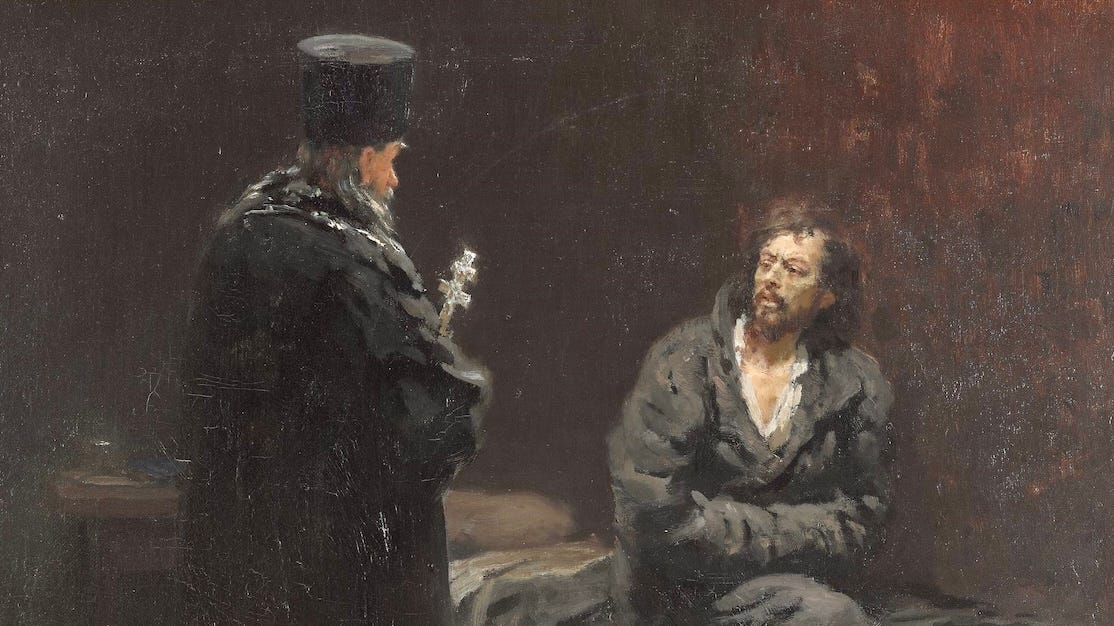
Here, almost anybody can understand where Ivan is coming from, and he communicates the problem of suffering just about as well as anyone else you’ve read. The sheer amount of pain and evil in the world is hard to understand. It is deeply challenging to those of faith. The problem, of course, is that the alternative is no better.
Ivan realizes that, if there is indeed no universal purpose, and everything is absurd, then there is surely no good reason to reject any action on fundamentally moral grounds. Instead, Ivan accepts total moral anti-realism: If God does not exist, anything must be permitted.
It is this principle that Dostoevsky finds most dangerous, and as we shall see, it makes Ivan’s statement that he would “destroy himself” more prophetic than he realizes…