

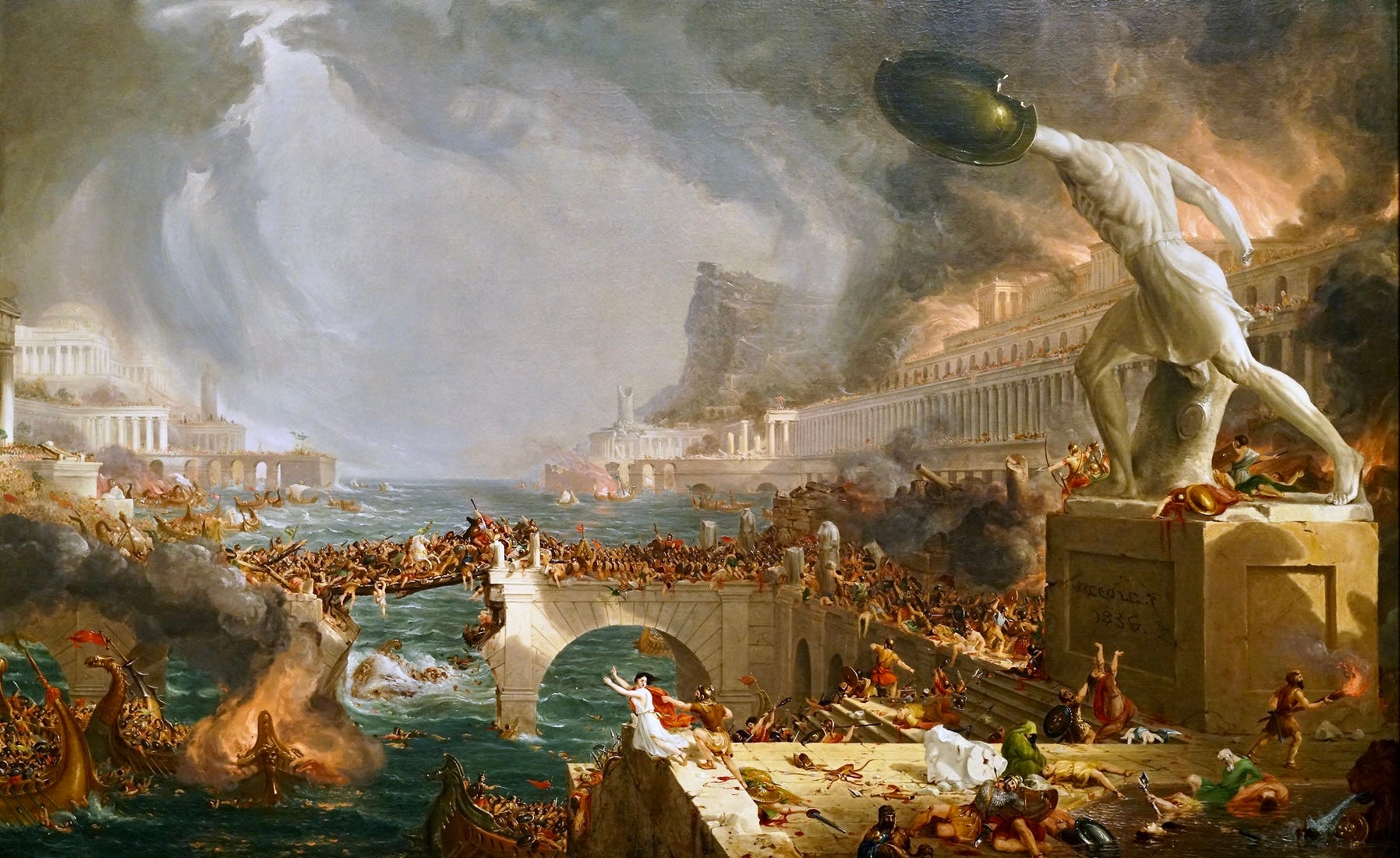
The world ended in 410.
Not the entire world. But the world that was known for almost a millennium, a world in which the empire of Rome governed, defended, ruled, and civilized Northern European, African, Middle Eastern, and Mediterranean peoples from Egypt to England, ended in 410. In that year, after many years of visible decline in and around the city of Rome itself, the Visigothic barbarians invaded and sacked the eternal city.
It’s difficult to imagine the psychological and political impact this attack had on Roman citizens. If there had been one constant in Western Civilization for the past near-millennium, it was the invulnerability and dominance of Rome over the rest of the world. Roman citizens were safe in the Roman empire, and they could live confident in their place in the greatest civilization in the world. Rome produced the best art, literature, philosophy, and, perhaps most importantly, soldiers in the world. What wasn’t to like?
Now that was shattered, left in a heap of destroyed buildings and dead corpses. And many Romans, especially the Roman aristocrats, knew who was to blame: Christianity.
Which is why the sack of Rome in 410 prompted the writing of perhaps the greatest work of theology between the Bible itself and St. Thomas Aquinas’s Summa Theologiae. It was written by St. Augustine of Hippo, and it would come to define Augustine’s reputation as a thinker. It was called The City of God.
Angering the Gods?
For centuries, the very core of Roman culture had been its religious system. The Roman religion had inspired the citizens of the empire to incredible acts of artistry, politics, and combat. Some of those acts can still be seen today, over 2000 years later.
As many know, that all changed when the Roman emperor Constantine issued the Edict of Milan in 313, officially establishing tolerance of Christianity in the Roman empire. Later, Christianity was made the official state religion, and the traditional Roman religion became the practice of only a few. Those who held on, however, warned that a reckoning was coming soon. The Roman gods had, for centuries, defended and propagated the Roman Empire across the globe. Now that the empire had abandoned them, those same gods were sure to abandon Rome. And what would become of the empire then?
One hundred years later, the Roman prophets seemed to be vindicated: Rome did fall. The borders of the empire rapidly receded, and barbarians began controlling vast swathes of what was, at one time, Roman land, including Rome itself. The Roman gods had indeed seen their vengeance wrought on those who had abandoned them.
The World’s Greatest Theologian
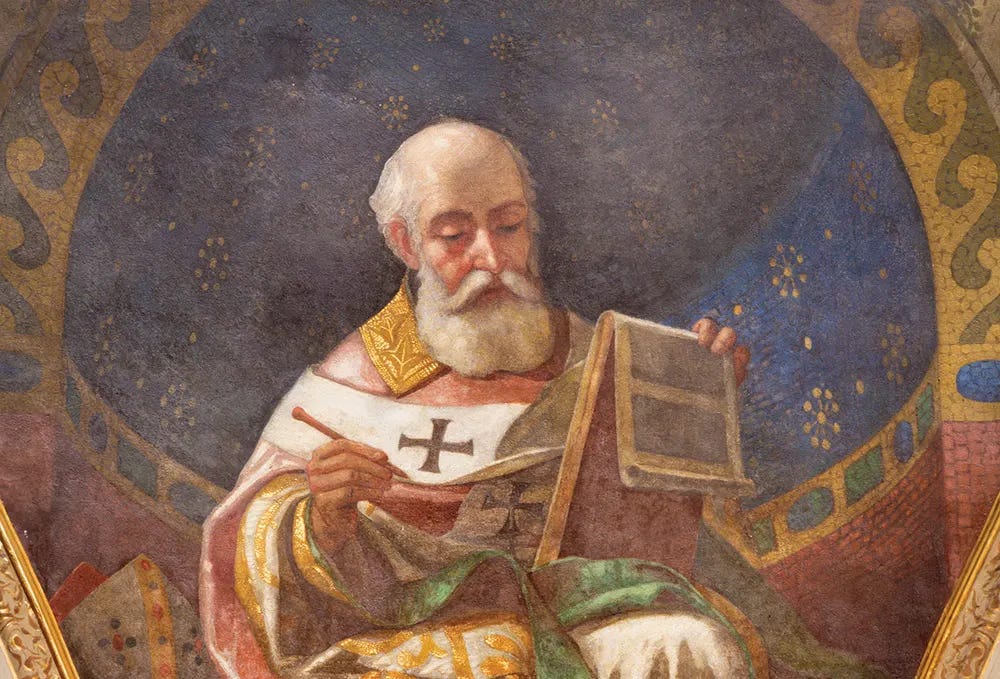
It was here that Christians appealed to the world’s greatest theologian, a man who still inspires and teaches millions: St. Augustine, Bishop of Hippo.
Augustine was already well-known as a prolific writer and erudite scholar; indeed, his true magnum opus, a work known as The Confessions, had already been published by this time. But whereas The Confessions was largely a work of autobiography with a healthy serving of philosophy mixed in, The City of God is a work of theology through and through.
Augustine began it in response to the many Romans who were blaming Christianity for the failure of the Roman Empire. But Augustine did not stop there. Instead, he took on a much more expansive goal: he sought to give a full account of history from the perspective of man’s relationship with God. While this would help to refute the Roman pagans, it would also achieve something much greater: it would help its readers to see all of history as a conflict between those who are following God, and those who are not. And his account would fundamentally impact Christendom’s view of the world for centuries after…
The Two Cities
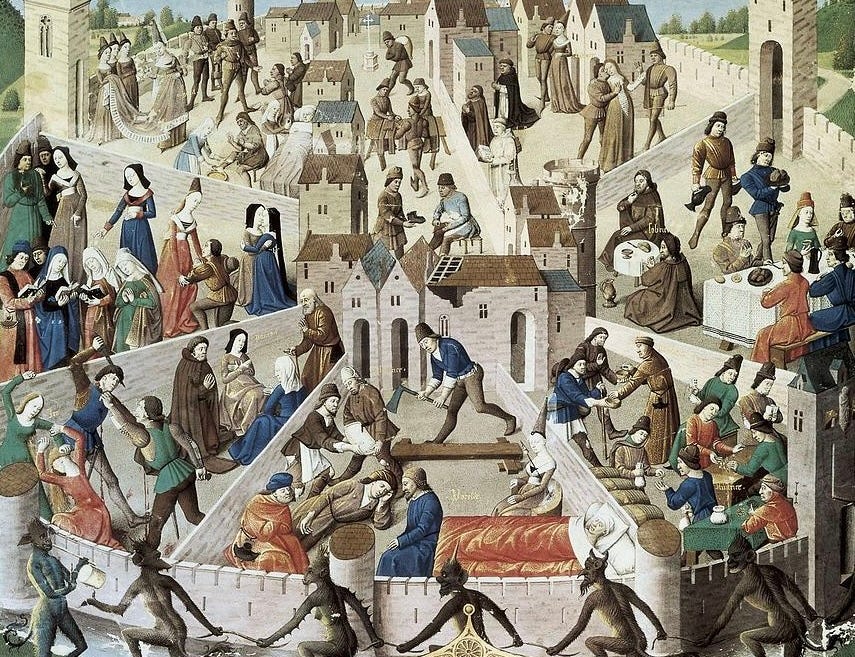
The City of God is not actually about one literal city, Rome, Hippo, or otherwise. Instead, the two “cities” are the two categories of people: those who sought to do the will of God, and those who sought to pursue their own will.
It is helpful, here, to remember that the people of Augustine’s day thought of a “city” as a much more cohesive whole than we do today. Whereas we now think of cities as, basically, larger, more centralized groups of people within a country, the ancients viewed cities as the fundamental political reality. The “city of God” and “city of man” would be titled something more like “the army of God” or “the nation of God” today.
Here is how Augustine scholar Etienne Gilson describes the two cities:
The two cities which he describes are, as we have seen, mystical, that is, supernatural, in their very essence. The one is the City of truth, of the good, of order, of peace; it is, indeed, a true society. The other, since it is defined as the denial of the former, is the city of terror, of evil, of disorder and confusion; it is, in fact, a mockery of a society worthy of a name.
In other words, every person has a choice: he can become a citizen of the City of God and look to serve his creator, or he can join the city of man, and seek to serve only his own personal goals.
In Augustine’s mind (as well as in his book), all of history is the presentation of the same question that is presented to each and every human person: whom will you serve? God or himself?
In The City of God, Augustine argues that we must serve God. This choice, while it presented itself starkly to the Romans grappling with the fall of Rome, still presents itself to us today, and it is why this work still matters 1600 years after it was written. Indeed, for anybody living through difficult or uncertain times, through a decline of their city or their state, The City of God reminds us that there are things higher and more permanent than Rome:
Lay hold now on the celestial country, which is easily won, and in which you will reign truly and for ever. For there shalt thou find no vestal fire, no Capitoline stone, but the one true God… Incomparably more glorious than Rome is that heavenly city in which for victory you have truth; for dignity, holiness; for peace, felicity; for life, eternity.
Read It With Us…
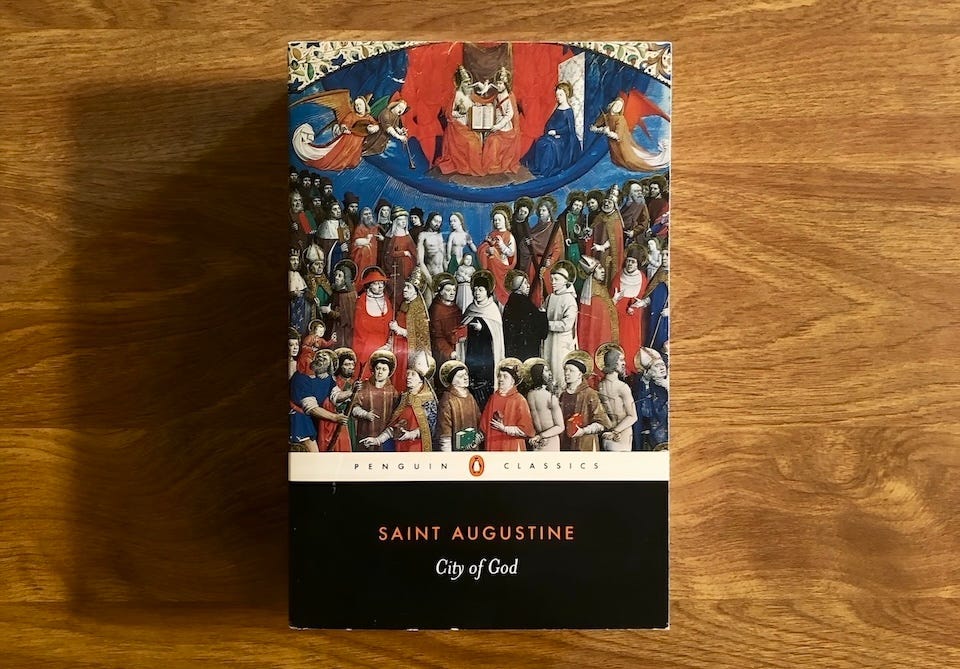
Our read-along of The City of God begins this week! Please join us — it’s going to be an incredible journey.
Since it would take many months to break down all 22 books in sufficient detail, the live discussions will instead focus on the heart of the work:
Discussion 1 (September 15):
Book 11 – creation, the angelic fall, and the origin of the two cities
Book 12 – evil as privation, and how a good creature can turn away from God
Book 14 – the two loves that found and distinguish the two cities
Discussion 2 (September 29):
Book 19 – peace, justice, and the proper ends of human community
Book 22 – resurrection, the beatific end, and the eternal rest of the City of God
Along the way, we’ll send out weekly reading guides for the books in question. Note: we are personally reading this version, the Bettenson translation (Penguin Classics).
You don’t have to have done the reading before the first call!
For a great place to begin, check out our discussion threads on Book 11 and Book 14 before you embark.
Join our reading group and participate in the live discussions by taking out a paid membership here:
As a member of our group, you’ll get:
Live book discussions (biweekly) and recordings
Access to our incredible community of readers
Essays and discussion threads to guide your reading
The entire library of articles, essays, and podcasts
Wonderful intro, thank you 🙏 See you Tuesday!
Thank you. I read the Introduction to the book, and am grateful the discussion starts here, not in some of the earlier chapters.