

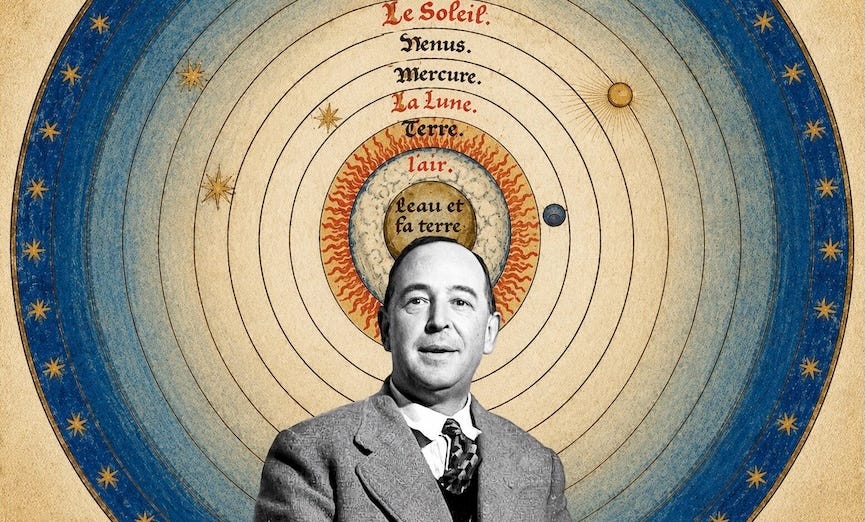
C.S. Lewis is often referred to as a “medievalist.” And not just because he had such an affinity for medieval literature — Lewis saw our modern modes of thinking as being in profound tension with those of our medieval past.
But why would one of the sharpest minds of the 20th century turn to the intellectual traditions of the Middle Ages for guidance?
To Lewis, the medieval worldview possessed a genuine answer to a very serious modern affliction: the feeling that we are strangers in our own universe.
Medieval man felt that he was an integral part of the universe, because of the “Medieval Model” through which he interpreted it. This Model may hold the key to reviving a sense of meaning today…
Don’t forget to join our book club!
We are about to start reading Aristotle’s Nicomachean Ethics — the first discussion is on Tuesday, June 9, at noon ET.
If you’d like to support our mission and join our reading group, please do consider a paid subscription. You’ll get:
All live book discussions (biweekly) and recordings
Regular essays to guide you through the books we’re reading
Access to our incredible community of readers
The full library of articles, essays, and podcasts
Ability to vote on what we read next…
The Medieval Model
In the last book he ever wrote, The Discarded Image, C.S. Lewis laid out what he called the Medieval Model: the framework through which medieval people understood the universe and their own place in it. This Model has its roots in the Medieval (and Ptolemaic) understanding of cosmology…
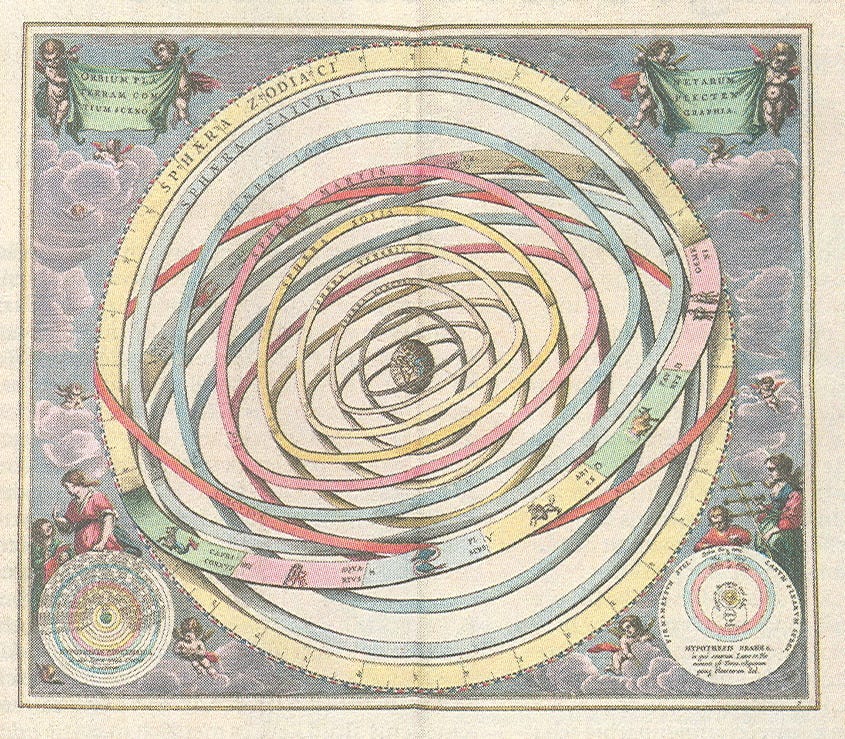
To give a (very!) brief overview for the purpose of this article, medieval man believed the cosmos to be geocentric. Just as in Dante’s Paradiso, the universe was understood as a series of celestial, concentric spheres (usually nine of them), with Earth, unmoving, at its centre. This cosmos hummed with harmonic music, as each of its rings was moved by a certain angelic Intelligence. Beyond the rings lay the realm of God.
Everything in the universe had its proper place in the Chain of Being, and the medieval scholar sought to integrate all new scientific discoveries within this framework. The universe was considered intelligible by the minds down here on Earth, who, crucially, were part of its very structure, and Man himself was felt to be a microcosm (literally a “little cosmos”) of the universal macrocosm.
Lewis referred to this unified whole as a “finely ordered multiplicity” — yes, the cosmos was known to be vast and enormously varied back then, but it was also orderly and unified. Where modern thought tends to have trouble reconciling multiplicity and unity (seeing them as opposites), medieval thought saw the overwhelming scale and variety of space and nonetheless agreed that it could be placed within the system.
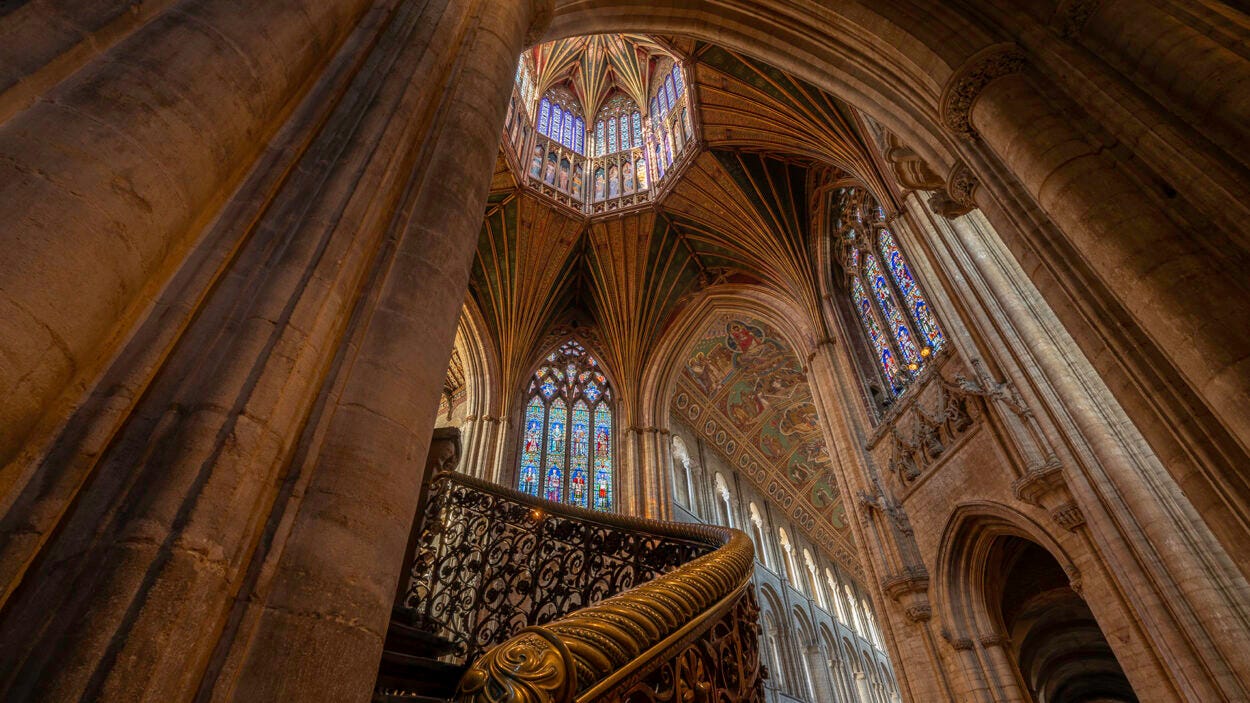
This all meant that medieval man looked at the night sky and saw a comprehensible system that he undoubtedly was part of. Space, of course, wasn’t understood back then to be infinitely expanding, and so looking up at space was more like looking up into a beautifully ordered cathedral than into a massive, unsettling abyss.
In Lewis’s language, medieval man stood at the bottom of a stair whose top was “invisible with light”; modern man stands at the top of a stair whose foot is “lost in obscurity.”
The 7 Liberal Arts
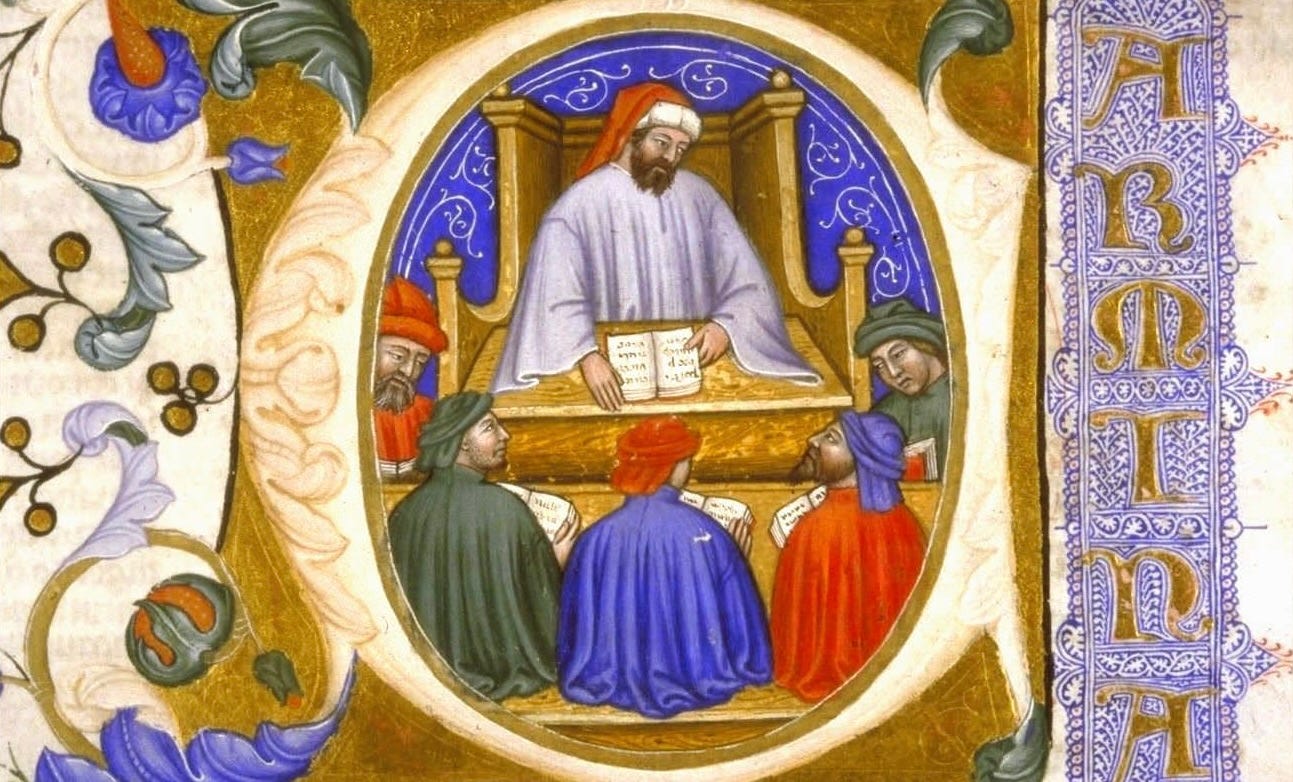
Lewis concludes his description of the Model with an explanation of the seven liberal arts. Integral to a medieval education was the idea that academic subjects weren’t distinct disciplines, but a connected web through which a soul was trained in its capacity to understand the universe as a whole. Scientific discoveries were not separable from, say, theology or philosophy, for they all came together to explain the pattern of reality.
A medieval university curriculum consisted of the trivium (grammar, logic, rhetoric) and the quadrivium (arithmetic, geometry, music, astronomy). Subjects were connected because they worked together to explain the nature of reality — music and math, for example, stood together as sciences because the universe was interpreted as a great symphony. Lewis explains how each discipline prepared the mind for the next.
Ultimately, the liberal arts trained a mind by mapping it to the inherent order of reality: “the medieval synthesis itself, the whole organization of their theology, science and history into a single, complex, harmonious mental model of the universe.“
Under the Medieval Model, all manner of human pursuits were pointed toward the same objective, the same telos: understanding ultimate Truth.
Lewis contrasts the Model to where we find ourselves today:
If I am right, the man of genius then found himself in a situation very different from that of his modern successor. Such a man today often, perhaps usually, feels himself confronted with a reality whose significance he cannot know, or a reality that has no significance… It is for him, by his own sensibility, to discover a meaning, or, out of his own subjectivity, to give a meaning – or at least a shape – to what in itself had neither. But the Model universe of our ancestors had a built-in significance.
Lewis knew full well that we cannot return to the Medieval Model, not least because advances in astronomy have contradicted its scientific claims.
But he saw great value in how it communicated to man a purposeful universe with built-in significance:
I have made no serious effort to hide the fact that the old Model delights me as I believe it delighted our ancestors. Few constructions of the imagination seem to me to have combined splendour, sobriety, and coherence in the same degree.
So, what did he recommend we do?
Unfortunately, there is no single, easy answer — but there are ways that we can subtly reframe our perspectives and see our reality as more meaningful.
In a short but profound essay, Lewis suggested one way to unshackle our modern minds…