

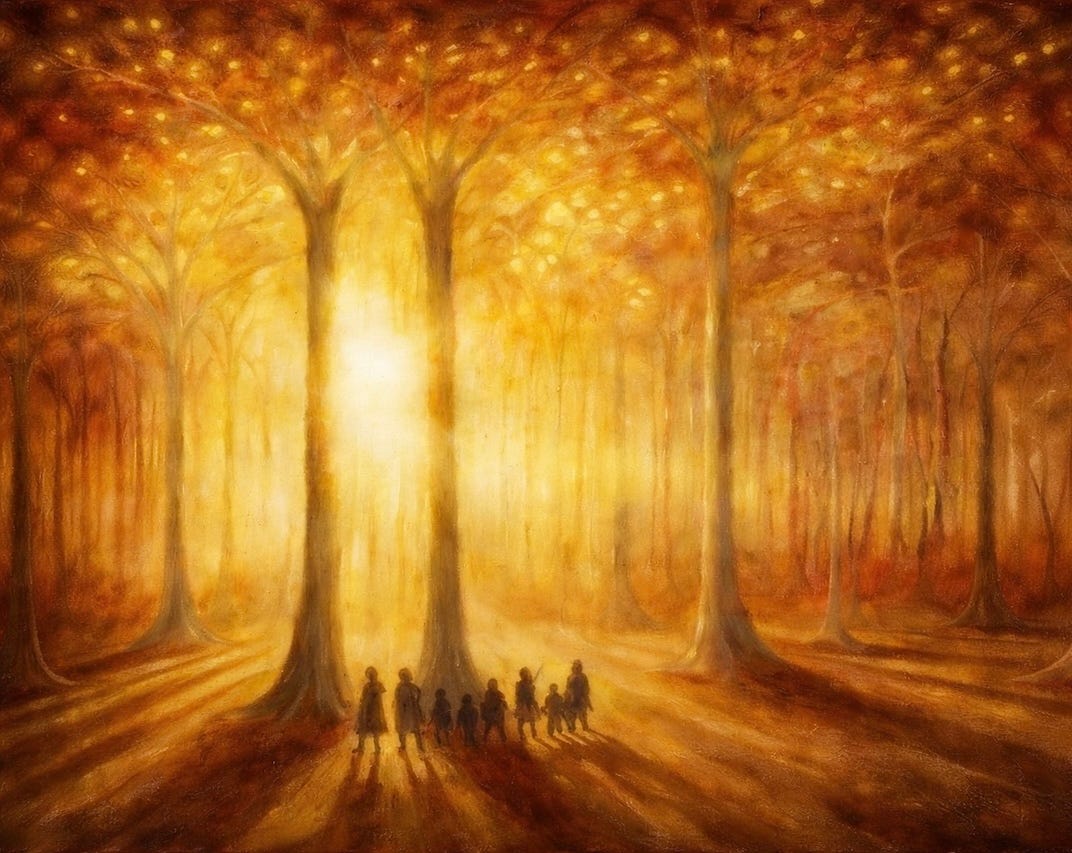
One of the most important chapters of The Lord of the Rings trilogy is the Fellowship’s stay in the Golden Wood of Lothlórien, shortly after Gandalf’s fall in Moria.
It is somewhat skipped over in the movies and often overlooked in general, but it’s a fascinating interlude that reveals something critical about the story as a whole — namely, the transformative power of beauty.
Lothlórien is the fairest Elven kingdom left in Middle-earth. When the Fellowship walks among its golden “mallorn trees,” they’re only seeing it in winter, yet it radiates such beauty that none of them have ever seen: “on the land of Lórien no shadow lay.”
When they first approach the wood, however, Boromir is wary of entering:
‘But of that perilous land we have heard in Gondor, and it is said that few come out who once go in; and of that few none have escaped unscathed.’
Aragorn suggests he replace “unscathed” with “unchanged,” but we soon learn that Boromir was right, in a sense. Because while Lórien’s beauty is nourishing and transformative for the visitors, it is also dangerous.
The journey in Lothlórien is an analogue to our own experiences with beauty — just as beauty restores our vision in life, it also wounds us deeper than any evil can…
Thank you for being part of our mission! If you’d like to support us and join the book club, please consider a paid subscription. You’ll get:
All live book discussions (biweekly) and recordings
Access to our incredible community of readers
The full library of articles, essays, and podcasts
We are about to start reading Dostoevsky’s Crime and Punishment! The first discussion is on Tuesday, April 28, at noon ET — join us!
A Timeless Place
The Fellowship is guided deep into the wood by the elf Haldir, passing through the boughs of its great trees, bathed in a golden light that shines through the canopy.
The sight is captivating, and when they reach the ancient heart of Lórien, Cerin Amroth, Samwise says he feels as though he is inside a song. This is a nod to the creation story of Tolkien’s universe, which was sung into existence through the Music of the Ainur (as we read in The Silmarillion). Lothlórien is a heavenly garden concept resembling Eden, and seeing it brings one closer to the “unfallen” beauty of Creation.
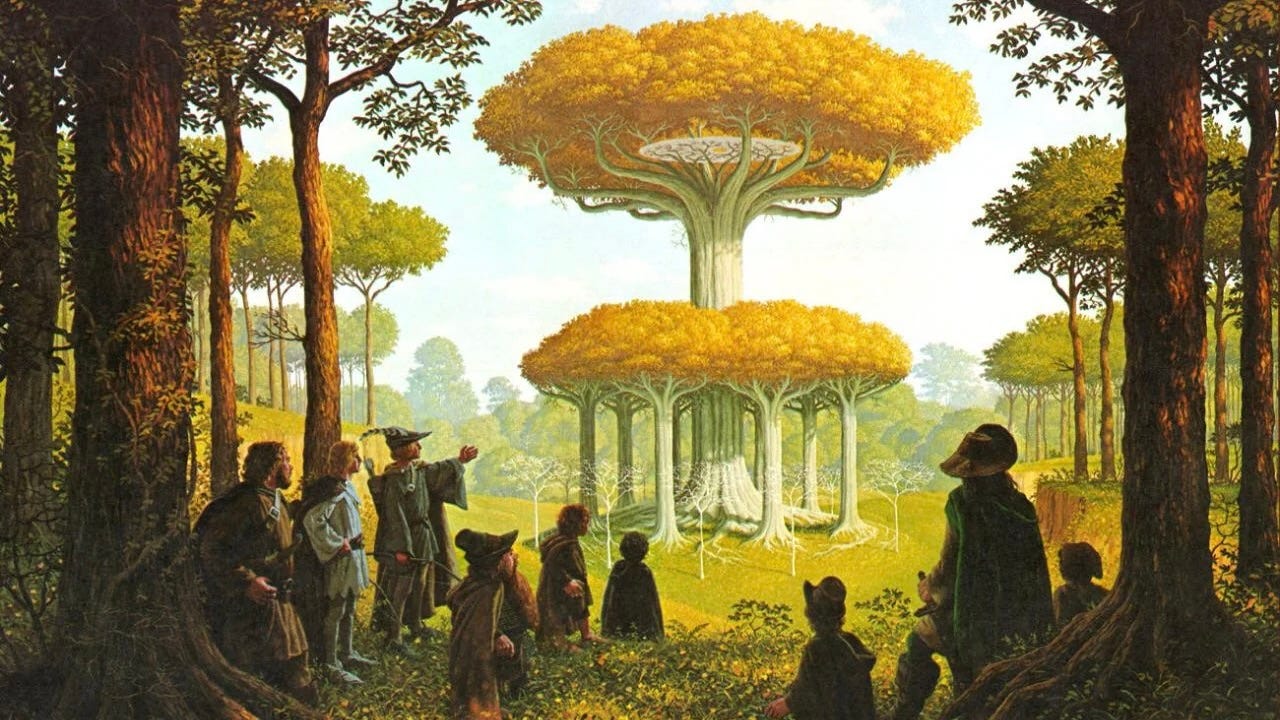
This is the first point to make about beauty. Beauty is a property that points to something far beyond the world we inhabit — it is where form has come into alignment with ultimate truth, with infinitude. Lothlórien is a glimpse of the eternal.
It is here that the Company completely loses track of the passing of time. Frodo wanders among the trees, suddenly more aware of their feel and texture than ever before. In this ethereal place the world feels more than real, and compared to the Golden Wood, everything else now seems “formless and vague” to Frodo.
He felt a delight in wood and the touch of it, neither as forester nor as carpenter; it was the delight of the living tree itself.
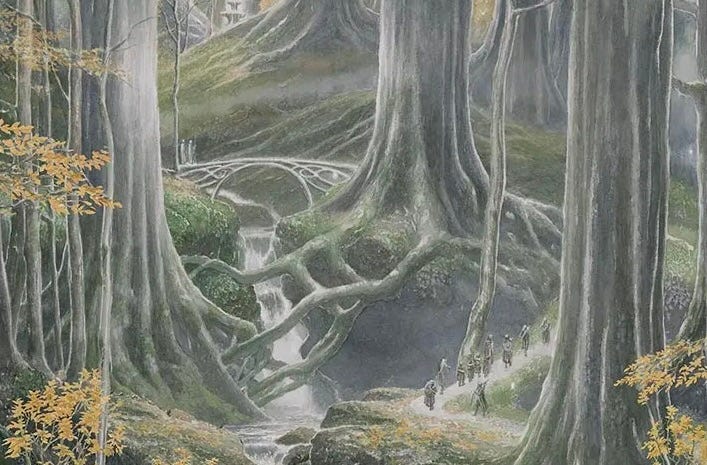
It’s well known that Tolkien abhorred the desecration of nature and wanted us to live in communion with all things that grow. The desire to harness nature is a hallmark of evil in Middle-earth, and one of Tolkien’s guiding concepts is that, to change the world, you should learn to participate as part of it first: “He that breaks a thing to find out what it is has left the path of wisdom.”
In Lothlórien, as when faced with any beauty, you’re invited to reconnect with a deeper truth about the way things are. Stopping to appreciate the world in this way — being in it instead of using it — refocuses our perspective. And because beauty points to an “unfallen” state of things, it reconnects us with our highest aims.
For the Fellowship, the interlude in Lothlórien comes after they ascend out of the terrible darkness of Moria, and so it is needed to reattune them to the beauty and goodness they set out to save — and it renews their desire to succeed.
Why Beauty Wounds Us
But this is only the start of Lothlórien’s lesson on beauty. Note that Gimli is the character most shaken by Lothlórien and the encounter with Galadriel, Lady of the Wood.
When the Fellowship departs for the next stage of their journey down the River Anduin, Gimli’s parting request of Galadriel is that he may take a single hair from her golden head — to which she responds by handing him three. The gift is a symbol of how Gimli is sustained and nourished by beauty, but it is not without a deep pain:
‘Torment in the dark was the danger that I feared, and it did not hold me back. But I would not have come, had I known the danger of light and joy. Now I have taken my worst wound in this parting, even if I were to go this night straight to the Dark Lord. Alas for Gimli son of Gloin!’
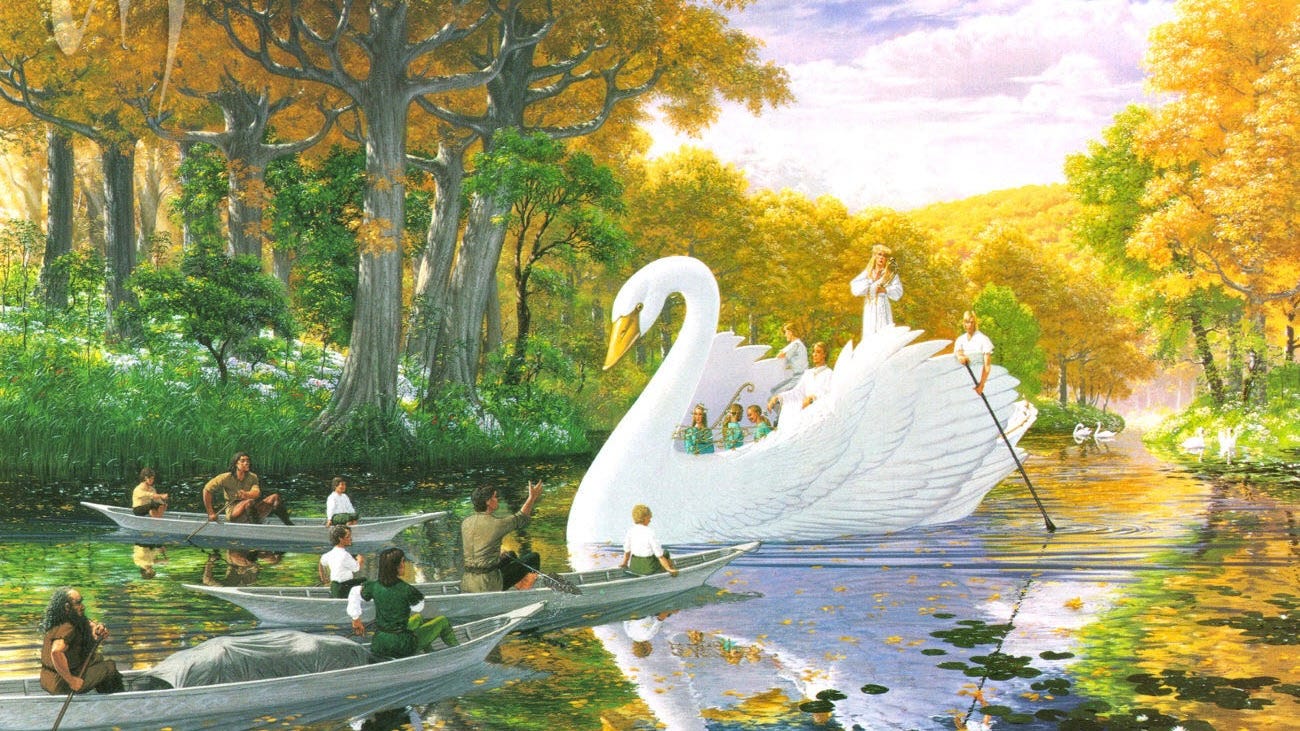
Gimli, by this point, has made it through much darkness and faced mortal peril more than once. When he joined the Fellowship, he was ready to confront all the evil that the world had to throw at him. He was prepared to go into the heart of Mordor and face down Sauron himself.
But Gimli was not ready to feel the light and love that he found in Lothlórien. It is, in his words, the worst wound of all.
Why would beauty strike such a wound in his heart? The answer to this is Lothlórien’s most significant lesson, and a moment of stunning profundity from J.R.R. Tolkien…