

Hello all!
Our read-along of The Brothers Karamazov is coming to an end. We meet tomorrow, September 1, at noon Eastern Time, to discuss Books 10–Conclusion.
Tomorrow’s session will be live streamed via Substack at this link.
For those joining our discussion group directly (available to all paid members), the Zoom link is at the bottom of this email…
Today’s thread will focus on Book 11, which finally returns us to Ivan, and continues the psychological unraveling that’s begun to unfold since the murder.
In this book, Ivan makes various visits to Smerdyakov. Recall that Smerdyakov is a vile nihilist, and though Ivan despises him, Smerdyakov considers him a good friend. This is because Smerdyakov understands the fullness of Ivan’s philosophy — that “without God, anything is permitted” — and he takes this proposition seriously.
Over their dialogues in this text, Smerdyakov slowly reveals that he has knowledge about Fyodor’s murder. Eventually, he confesses outright that he himself was the murderer, directly inspired by Ivan’s philosophy.
At this news Ivan is fraught with guilt, disgust, and illness, as he sees his culpability in his father’s murder.
This illness leads to one of the book’s most famous and striking scenes:
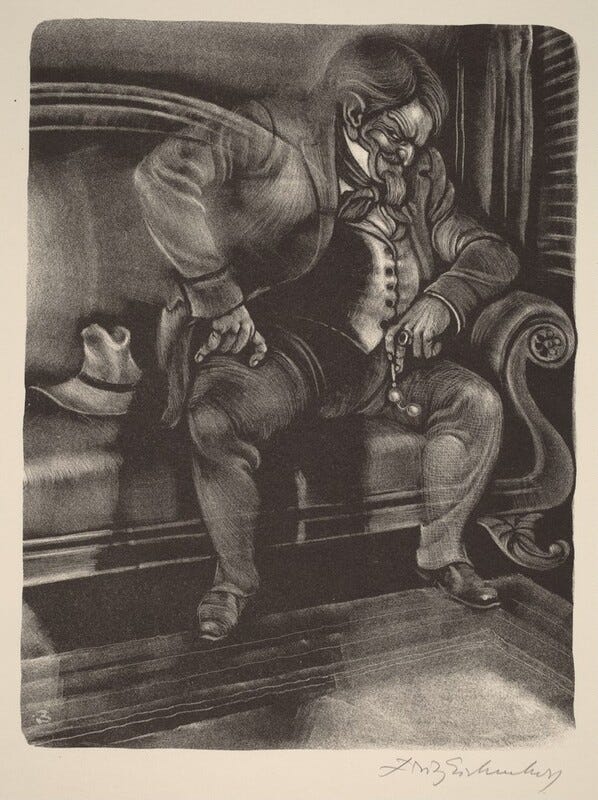
Ivan has a hallucinatory conversation with the devil, who appears to him as a tired, shabby, banal bureaucrat. It’s an absurd portrait, almost a direct inversion of the classic “grand seducer” image we associate with the devil, but this doesn’t make the devil’s attacks any less powerful. He affirms Ivan’s greatest fears — that the devil is real, Ivan is guilty, and that Ivan himself is too weak a man to have faith in grace, God, and love for his neighbor. Shortly after, Ivan passes out into a delirium of brain fever, losing his grasp over his faculties.
Some questions/ideas to ponder:
Smerdyakov insists that Ivan is the real murderer, and that Smerdyakov himself was just the instrument who carried out his beliefs. Consider whether this is true, and whether or not Ivan shares in the moral culpability of Fyodor’s murder. Also consider how this relates to Father Zosima’s assertion that everyone is guilty of all before all.
Recall also Ivan’s thesis in Book 5 — that without God “everything is permitted.” How well does this theory hold up in practice, in light of Book 11? Is Ivan correct? Does he really believe everything is permitted? How does his illness help or hurt the validity of his philosophy?
Again, Dostoevsky’s devil is deliberately portrayed as a banal, whining, uninspired bureaucrat. Why does Dostoevsky choose to render evil in such a deflated and unglamorous manner? Why is the devil — the root of all evil — considerably weaker and less impressive than Ivan himself? What might this suggest about the nature of true evil?
Share your thoughts below or in the subscriber chat, along with any questions you have — we’ll incorporate them into the discussion!