

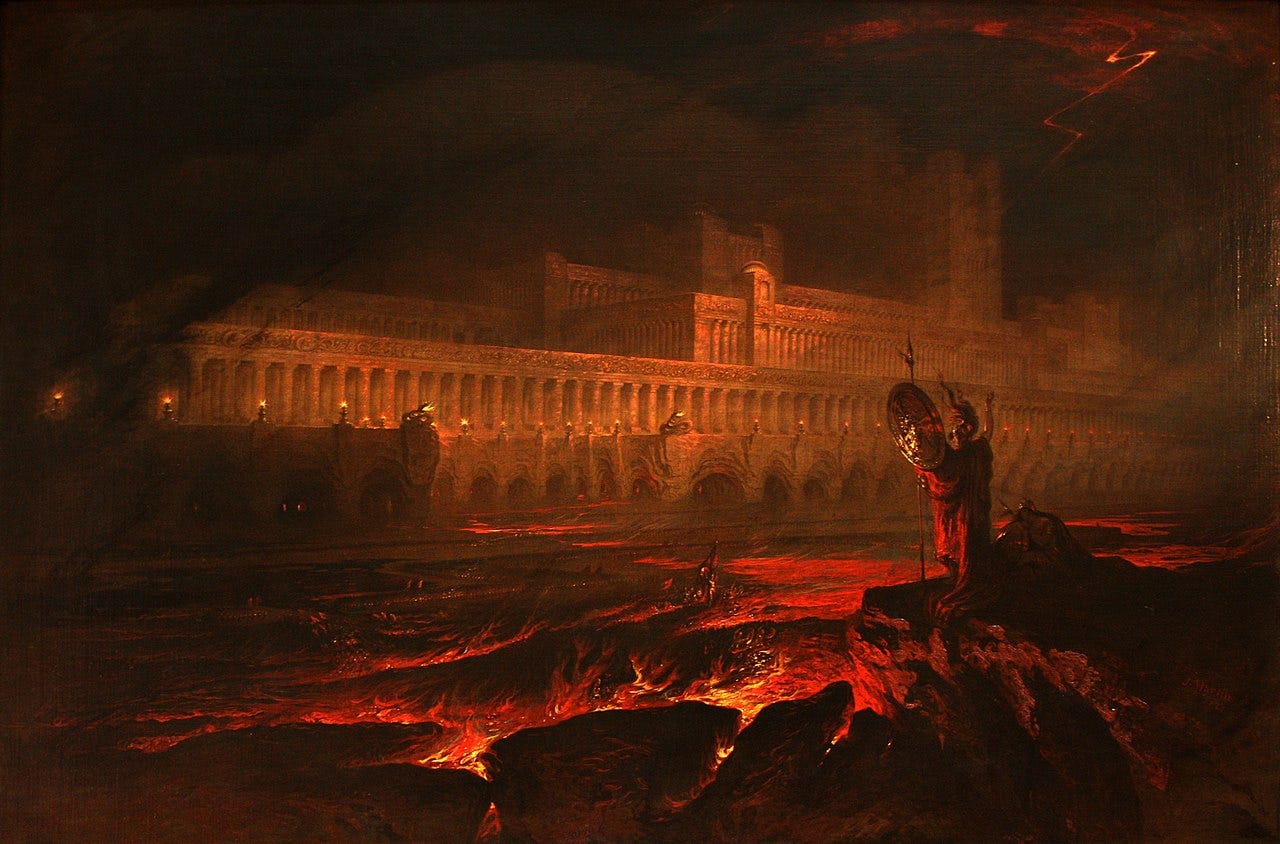
John Milton’s Paradise Lost features one of the greatest portrayals of evil in literary history.
The poem is a theodicy, Milton’s attempt to “justify the ways of God to men.” In it, he dramatizes the Biblical Fall of Man to tackle one of the most difficult questions of all time:
Why would a good God allow a world full of evil, suffering, and injustice?
Milton’s epic poem, first published in 1667, became immediately controversial for its radical, romanticized portrayal of Satan. Many critics have gone so far as to claim Milton was on the Devil’s side without knowing it.
Paradoxically, however, it is specifically because Satan is so appealing to the reader that Milton's genius is revealed. For Milton understood the nature of evil like few poets ever have, and shows that behind the glamour and wonder of Satan’s “heroism” is a rotting decay that shows how corrupting and damning evil truly is.
Here, then, is Milton’s take on the cosmic birth of evil, why evil is so enticing to mankind, and the only true defense against its corrupting influence…
Don’t forget to join our book club!
We have just voted to read Dostoevsky’s The Brothers Karamazov next! The first discussion will be on Tuesday, August 4, at noon ET — join us!
To support our mission, please consider a paid subscription. It makes a HUGE difference to the time and resources we can dedicate. You’ll get:
Live book discussions (biweekly) and recordings
Access to our incredible community of readers
Regular essays to guide you through the books we’re reading
The entire library of articles, essays, and podcasts
A Failed Rebellion
The first two chapters of Paradise Lost take place in Hell, where Satan and his demons mourn in despair over their recently failed rebellion. They lament that God is far more powerful than they ever conceived, and now admit that he is indeed master of the universe.
In the words of one demon:
“I now of force believe [God is] Almighty, since no less
Than such could have o’erpowered such force as ours”
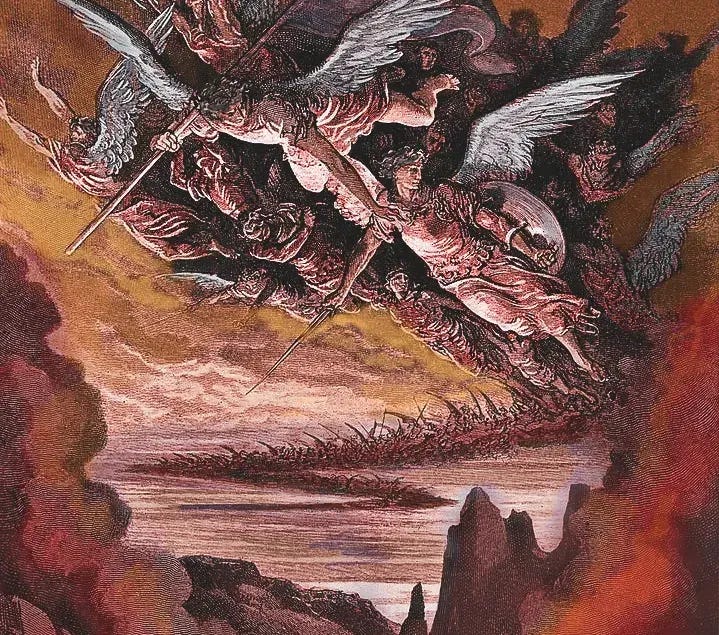
Already we get a glimpse into the psychology of evil. The demonic host admits that God is the true ruler, but does so on the basis of his power. Notice how the demons never acknowledge his goodness or justice — Milton is teaching us that the psychology of Hell is one where might makes right, a world that is “beyond Good and Evil.”
Though the demons despair over their loss of Heaven, Satan still proclaims the new cry of the underworld, and it is the most quoted line of the entire epic:
“Better to reign in Hell than serve in Heav’n!”
This is Satan’s pride speaking, which Milton makes clear is the cosmic birth of evil in the universe. For Milton, Satan (once the greatest of all the angels) rebelled out of jealousy of Christ, and preferred an eternity of damnation rather than bending the knee in submission. Already the stakes are high, but the evils of Hell prove even more complex and sinister in the next chapter.
The Council of Hell
Satan’s first move as the ruler of Hell is to summon a war council of his advisors.
The demons propose a range of responses to their defeat. Some urge another assault, others recommend peace for the sake of survival, and still others suggest scouring Hell’s depths in search of profit.
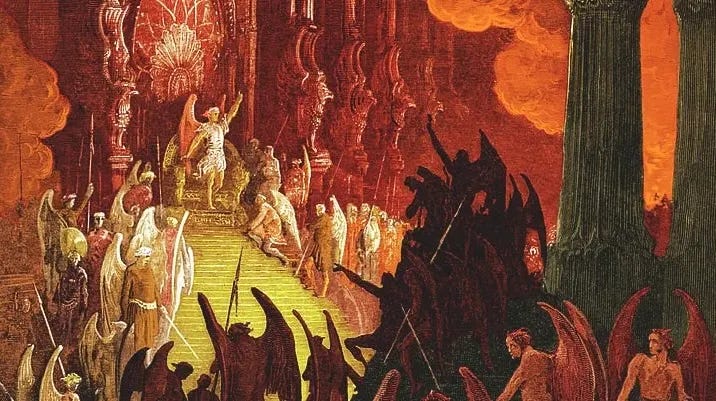
Here, Milton is further increasing the complexities of evil, namely, that it has no real identity. The demons are not just searching for a plan of action, but rather trying to understand their life’s purpose.
Before the rebellion, their lives were contingent upon serving and loving God. Now, their plans only involve some form of corruption or revenge against their heavenly father. Milton’s lesson for us is Augustinian: evil cannot exist by itself.
To make sense of this, think of a hole that has been dug into the ground. Evil exists in the same way that a hole in the ground exists — the hole cannot exist without the ground because the hole is an absence of ground. In the same sense, Evil is but a corruption or absence of the Good — it only exists in relation to the Good.
Finally, the war council agrees on a plan. Satan himself will leave Hell in search of a rumored new cosmos where God has created man. They agree that the best revenge against God will be to corrupt this mankind, and this now becomes the identity of evil — the permanent enemy to God and to the Good.
Up to this point, Milton’s portrait of evil has been grandiose and striking, yet largely familiar. As Satan departs, however, the poem takes a startling turn.
At the gates of Hell, Satan encounters two wicked monsters that are strange and foreign to him. He soon learns that they are his own grotesque offspring, born from his rebellion, and their appearance reveals a shocking lesson about the root of all evil…