

Hello book club!
Our next read-along has been decided, and it’s a significant one...
Saint Augustine’s City of God.
This is a foundational work of the Western canon. Quite possibly the greatest work of Christian thought. It will be one of our most rewarding — and challenging — reads thus far. If you’ve been on the fence about joining our group, now is the time…
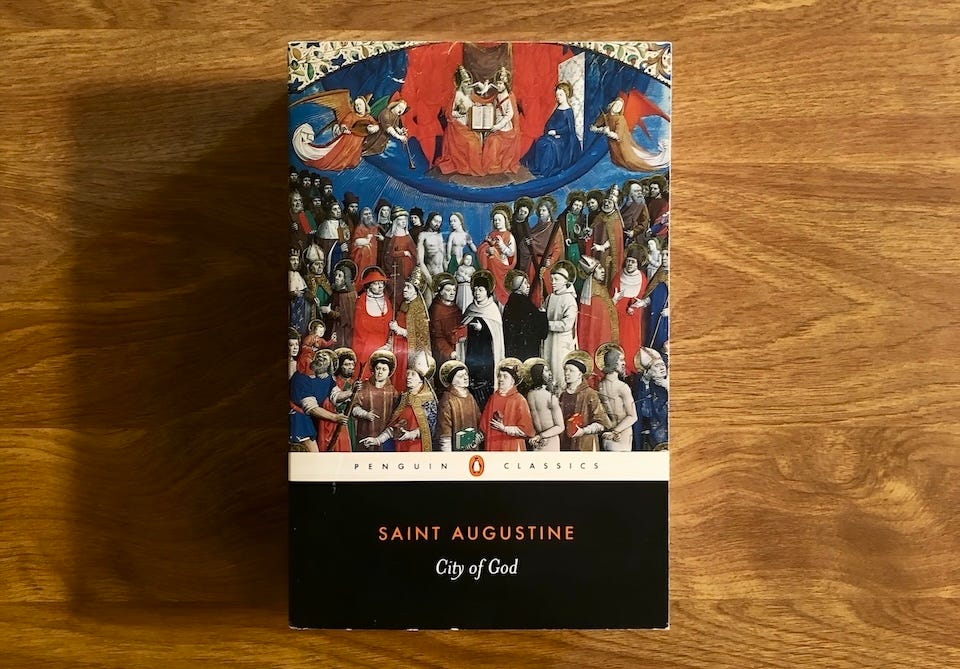
The City of God is a long, complex philosophical work. It would take many months to break down all 22 books in sufficient detail, so instead, we’re going to make this read-along an “intro to the City of God.” The live discussions will thus focus on the heart of the work:
Discussion 1 (September 15):
Book 11 – creation, the angelic fall, and the origin of the two cities
Book 12 – evil as privation, and how a good creature can turn away from God
Book 14 – the two loves that found and distinguish the two cities
Discussion 2 (September 29):
Book 19 – peace, justice, and the proper ends of human community
Book 22 – resurrection, the beatific end, and the eternal rest of the City of God
Along the way, we’ll send out weekly reading guides for the books in question. Note: we are personally reading this version, the Bettenson translation (Penguin Classics).
To begin, then, below is some key context to the work, and our first weekly discussion thread focusing on Book 11…
A Tale of Two Cities
In the early 5th century, the civilized world was falling into chaos. Rome itself was violently sacked in 410 AD, and its provinces faced being plunged into darkness. An order that had once seemed impenetrable was no more: if even the Eternal City could fall, then surely nowhere was safe.
At the time, pagan critics blamed Christianity for the catastrophe, claiming Rome’s fall was judgment for betraying its pagan past. It was in this context that Augustine of Hippo, a theologian and philosopher living in the Roman province of Numidia, was inspired to give a defense of the Christian faith. In The City of God, he rebukes and dismantles pagan religion and philosophy — yet in totality, it became far more ambitious a work than a mere pagan hit piece.
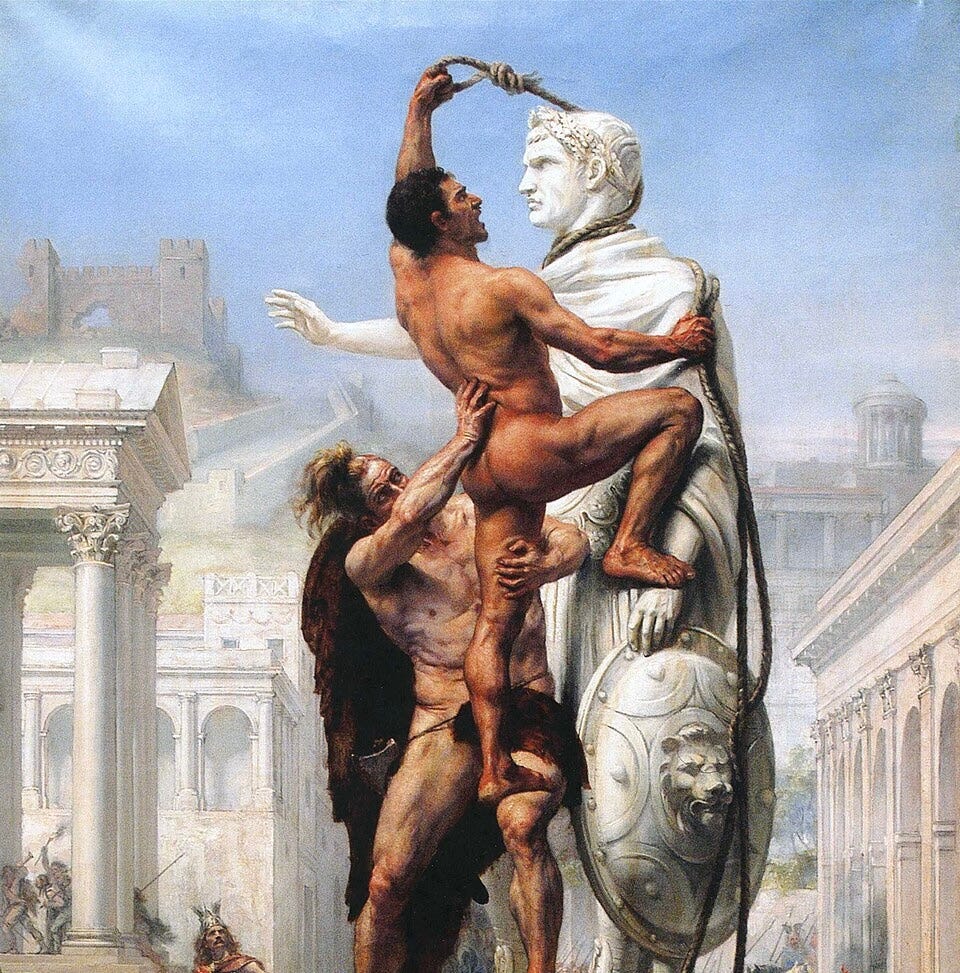
Ultimately, the work became a 1,000-page masterpiece offering a deep inquiry into human nature, history, politics, and civilization itself. And though it promises to give a totalizing account of mankind’s story, its genius can be boiled down to a single idea:
All of human history can be understood as a tale of two cities; namely, the City of God, and the City of Man.
Through this framework, Augustine seeks to provide an answer for anyone living through a difficult or uncertain age. But rather than a manual for saving a collapsing empire, or any political body, The City of God asks a deeper question:
What ultimately makes a society flourish?
The answer is not what you’d expect — in the end, a civilization’s true destiny is determined by what it loves...