

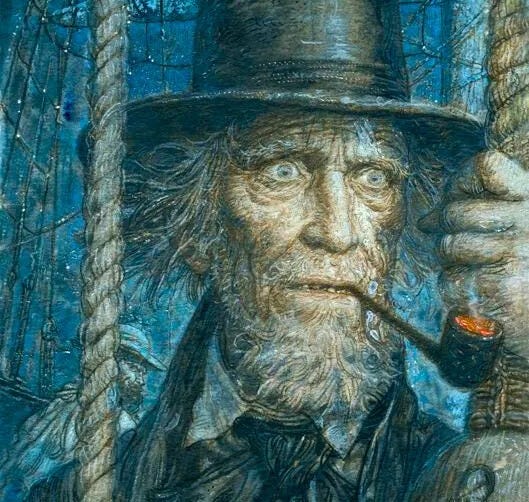
Why is Moby-Dick considered by so many to be the Great American Novel?
The answer starts to become clear when you examine what the central drama of Melville’s tale is trying to communicate.
In the story, we witness the infamous hunt of a giant sperm whale by Captain Ahab. This hunt is framed with Biblical allusions that prophesy a divine judgment and apocalypse for the whaling crew — at the center of which is the mad captain who asserts that no amount of bloodshed is too much if it destroys the great whale. At its core, then, this novel is a warning against vengeance and unbridled ambition.
However, be careful: Captain Ahab is guilty not just of unbridled ambition but also of an unforgivable sin — and a kind of evil that is far more seductive than you might think.
Just what is this unforgivable sin?
Let’s dive in, and see what Moby-Dick reveals about human nature, evil, and the pride that corrupts all creation…
Our next read-along is about to start!
We will read Moby-Dick together over the next 6 weeks. The first discussion is on Tuesday, October 13. Join us.
Read Moby-Dick as a member of our group and you’ll get:
Live book club discussions (biweekly) and recordings
Weekly reading guides and regular essays to guide you
Access to our incredible community of readers
The entire library of articles, essays, and podcasts
A Prophetic Warning
The novel begins with protagonist Ishmael, a young man disquieted by idle life in the countryside, whose yearning soul calls him to the seas. He takes a commission aboard a whaling ship, The Pequod, and expects to find a living, and perhaps adventure, by braving the seas. Unfortunately, he’ll soon discover he’s not aboard any regular whaling ship, and his captain is not just any ordinary captain.
Captain Ahab is the ship’s infamous leader. He’s described as a grizzled older man with the hardened facial features of a long-suffering, vengeful spirit. He hobbles around on a peg leg, because a great white whale named Moby Dick devoured his leg during a previous expedition.
Unbeknownst to the crew and the ship’s owners, Ahab is not planning an ordinary whaling expedition this time. He is piloting the ship for one purpose: revenge against the whale. Ahab is ruled by a vengeful monomania to murder Moby Dick, and Melville describes his hatred with chilling clarity:
“The White Whale swam before [Ahab’s mind] as the monomaniac incarnation of all those malicious agencies which some deep men feel eating in them, till they are left living on with half a heart and half a lung… All that most maddens and torments; all that cracks the sinews and cakes the brain; all the subtle demonisms of life and thought; all evil, to crazy Ahab, were visibly personified, and made practically assailable in Moby Dick. He piled upon the whale’s white hump the sum of all the general rage and hate felt by his whole race from Adam down…”
So, Ahab views Moby Dick as evil incarnate, as the original sin felt by humanity since the Fall of Man. And haunting prophecies hang over Ahab’s quest to defeat it...
Prophecies of Doom
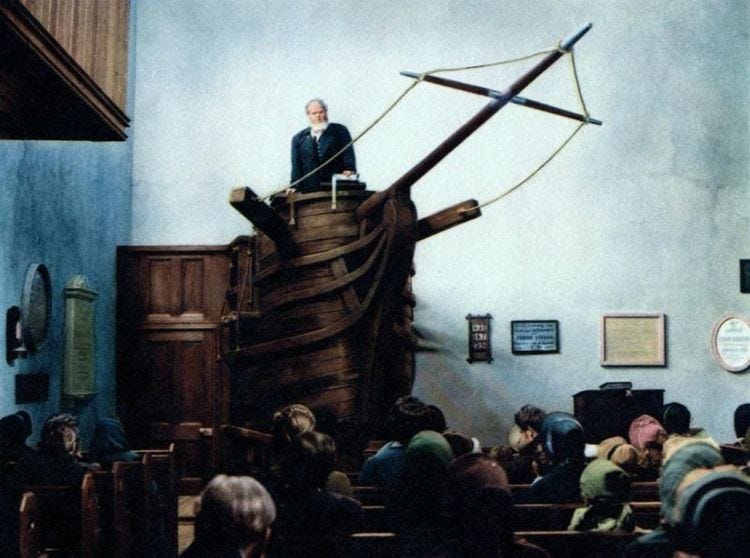
Several prophecies warn Ishmael before he sets out to sea. He first listens to a sermon about Jonah, the unfaithful prophet in the Old Testament who is consumed by a whale. Soon after, Ishmael gets accosted by a madman named Elijah on the docks, who delivers a stark warning:
“Ye’ve shipped, have ye? Names down on the papers? Well, what’s signed, is signed; and what’s to be, will be; and then again, perhaps it won’t be, after all.”
In scripture, Elijah was the prophet who urged the wicked King Ahab to repent in vain. Thus, the message is clear: Captain Ahab’s quest for vengeance is a selfish mission of pride and wrath that insults the face of God himself. This Elijah figure warns, “what’s to be, will be,” hinting that Ahab’s mission is fated to doom from the beginning.
What’s shocking, however, is that Ahab does not seem to care. In fact, he is fully aware that he may be sentencing his crew to damnation. Consider these lines he says of the whale, at various points in the novel:
“Towards thee I roll, thou all-destroying but unconquering whale; to the last I grapple with thee; from hell’s heart I stab at thee; for hate’s sake I spit my last breath at thee. Sink all coffins and all hearses to one common pool!”
“I’ll chase him round Good Hope, and round the Horn, and round the Norway Maelstrom, and round perdition’s flames before I give him up.”
“Talk not to me of blasphemy, man; I’d strike the sun if it insulted me.”
Ahab sees himself as a blasphemer who would strike the sun [God], and will sink “all coffins and hearses,” into a common pool to destroy the whale. Ahab’s crew, his own life, and even Providence itself are all worthy sacrifices if it means he can defeat the whale.
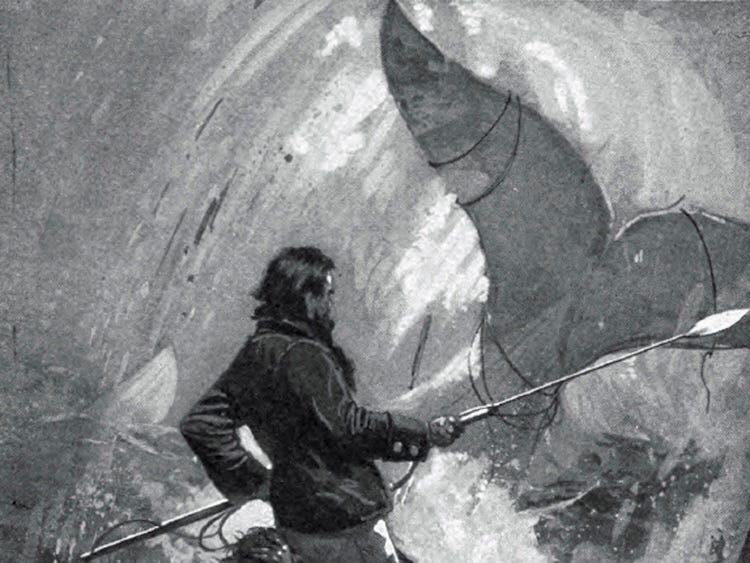
And this is what makes Ahab so memorable. He’s a man who donned a Satanic psychology, yet ironically, is using this psychology of evil to purge what he believes to be evil himself. Perhaps it is no wonder that such a man would gladly destroy himself to destroy the whale…
Yet jarring as Ahab is, we still haven’t gotten to the roots of his own evils, insanity, and quest. As we’ve mentioned already, Ahab is guilty of the “unforgivable sin” — but what exactly is that sin?