


Hello book club!
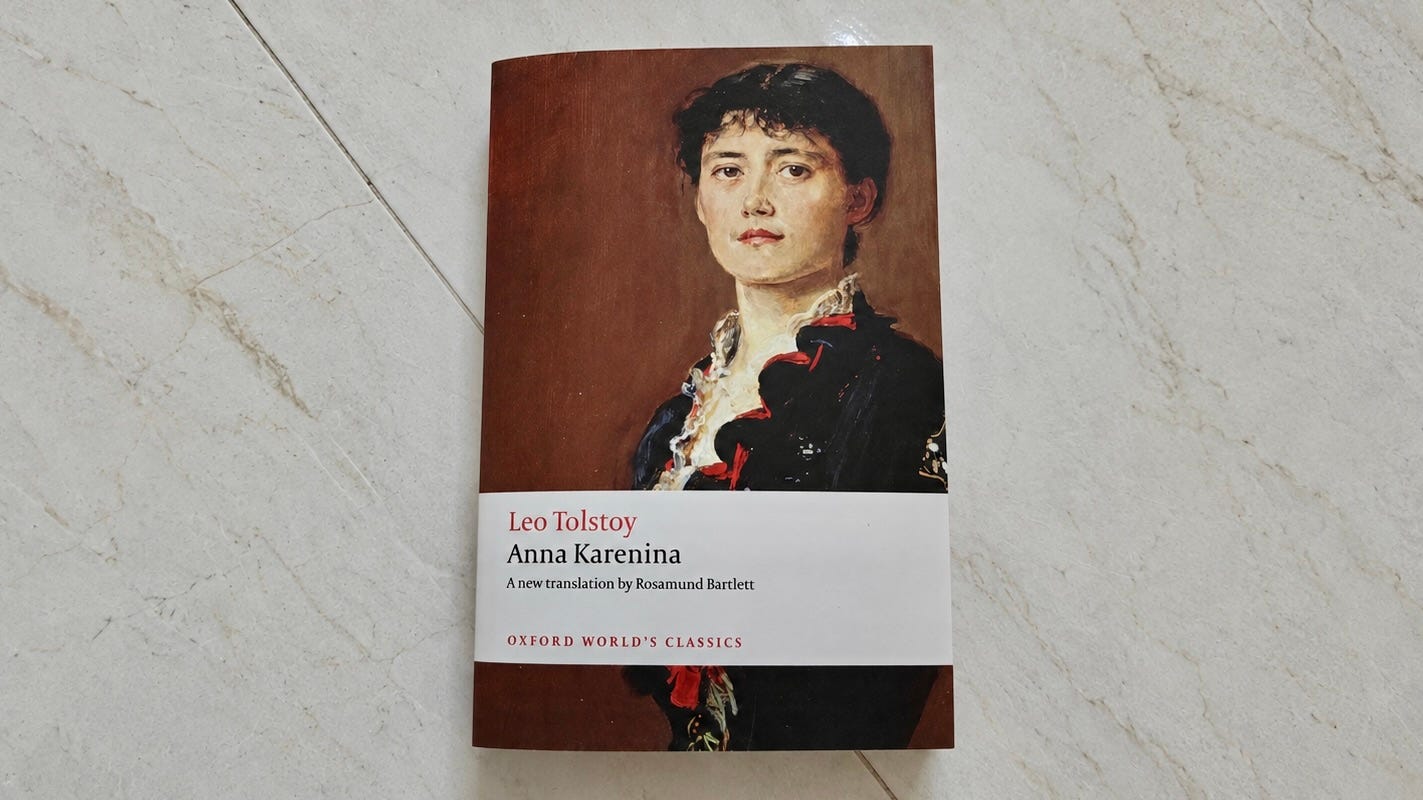
It’s finally time for our first discussion on Tolstoy’s Anna Karenina. We meet TOMORROW, November 24, at noon ET. We’ll be discussing the background to the novel and the key concepts at play in Parts 1 and 2.
Here is this week’s breakdown of the main ideas and questions to consider…
The first discussion will be livestreamed via Substack at this link.
For those joining our discussion group directly (available to all paid members), the Zoom link is at the bottom of this email…
You can join our reading group by taking out a paid membership here:
Study the great works of the Western canon alongside us. You’ll get:
Live book club discussions (biweekly) and recordings
Weekly discussion threads to guide the reading
Access to our incredible community of readers
Our entire library of essays, articles, and podcasts
Part 2 of Anna Karenina tracks the beginnings of Vronsky and Anna’s relationship.
Notably, rumors start far before an affair even takes place. Tolstoy emphasizes how the “high society” of St. Petersburg is akin to a small town where everyone knows each other.
In particular, Anna’s social circle is frequented by “le beau monde,” or the world of balls, dinners, and dazzling gowns, as Tolstoy puts it. Vronsky ingratiates himself into this society and openly flirts with Anna in front of her husband, which she welcomes.
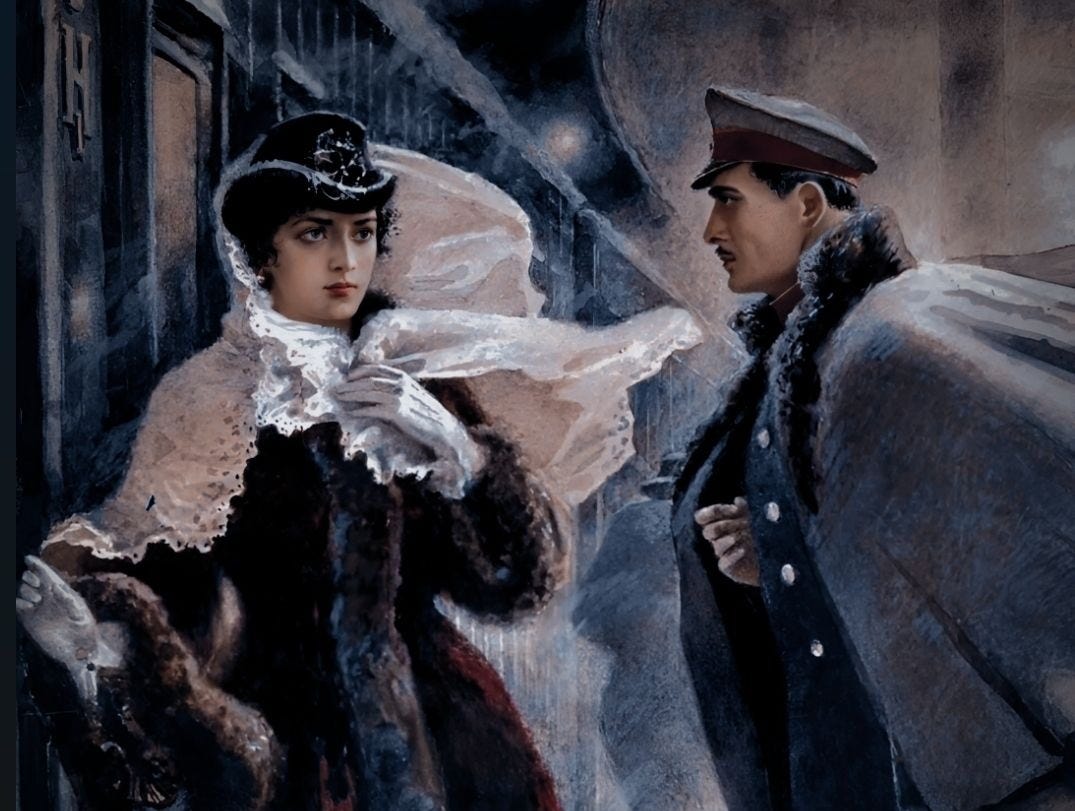
This flirtation draws attention and disapproval from onlookers, emphasizing a lack of discretion from the couple who are not merely courting scandal but doing so publicly without shame.
This flirtation becomes a full-blown affair in Chapter 11. Noticeably, Anna is distraught with guilt and misery at her infidelity. Vronsky is troubled too, but notably — he does not regret the affair itself, but is troubled by Anna’s unhappiness.
Between the two lovers Tolstoy emphasizes a differentiation of spirit:
Anna’s soul has been given a proper moral formation in which she is attuned to a felt sense of right and wrong. Vronsky, however, who was raised without a father and a licentious mother, has no solid moral comprehension. He doesn’t act from malice, but fundamentally is incapable of recognizing infidelity as a moral transgression.
Notably, the two lovers will cling to each other hereafter, as Anna laments:
“It’s all over. I have nothing but you. Remember that.”
And while things are admittedly grim between the couple, we’re introduced to a new character who begins one of the most satisfying moral arcs in the novel.
Kitty, who’s been heartbroken and hospitalized after Vronsky’s rejection, not only learns how to recover from heartbreak, but also understands how her suffering can lead to an authentically moral and redemptive life…
Specifically, upon recovering her health in a German spa, she befriends two Pietists named Varenka and Madame Stahl. The idealist girl is won over by a newfound belief that happiness is grounded in self-sacrificial love, caring for one’s neighbor, and spreading the gospel.
Soon, however, her father will arrive to temper her idealism — she realizes Madame Stahl is hypocritical towards her religious ideals — which will disillusion our protagonist but help her return to Moscow as a wiser, morally mature woman. No longer will she be subject to ill-thought erotic whims from the likes of Vronsky and the vain aristocracy, but will now seek to build a new life on the basis of prudence, morality, and regard for her fellow man.
Notably, these sentiments are echoed by Levin, who himself has recovered from Kitty’s rejection via honest labor and civic duty on his farm. He too still carries scars from his shame in the city, but has been made wise through his perseverance and toil.
Tolstoy appears to imply that the road to redemption, meaning, and proper maturation requires some modicum of suffering, fortitude, and perseverance — that moral clarity is preceded not by the glamours of high society, but the proper handling of suffering in the righteous pursuit of marital love.
Some questions/ideas to consider:
Consider the distinction between Anna and Vronsky’s initial reactions to their newfound affair: Anna is guilt-riddled, whereas Vronsky is principally troubled by her unhappiness. What does this difference reveal about their respective characters? Is Tolstoy suggesting that the two lovers possess fundamentally different understandings of love and moral obligation?
Kitty becomes enamored with Varenka and Madame Stahl and begins attempting to model her life around self-sacrificial love and service to others. But how much of this transformation is genuine virtue compared to idealistic imitation? What exactly does Kitty’s father help her recognize in Madame Stahl, and what does this reveal about authentic piety?
Both Kitty and Levin experience profound romantic disappointment. Yet their suffering seems to mold their souls for the better — both aspire to grander pursuits than mere romantic gratification. How then, does Tolstoy posit suffering as an occasion for moral development?
Consider the contrasting paths of Kitty’s and Levin’s redemption arcs — the former oriented towards charity and service, the latter through productive labor and civic duty. What do these parallel arcs suggest about human nature, along with the nature of male and female? What might we discern about human flourishing as such?
Share your thoughts below or in the subscriber chat, along with any questions you have. We’ll incorporate them into tomorrow’s discussion!